Whitepapers & ebooks
How to Choose a WMS Without Locking Yourself In
Most companies that end up stuck with a warehouse management system locked themselves in during selection. Where lock‑in is built, how to avoid it, and when a new WMS is the wrong project.
25. november 2026
10 min
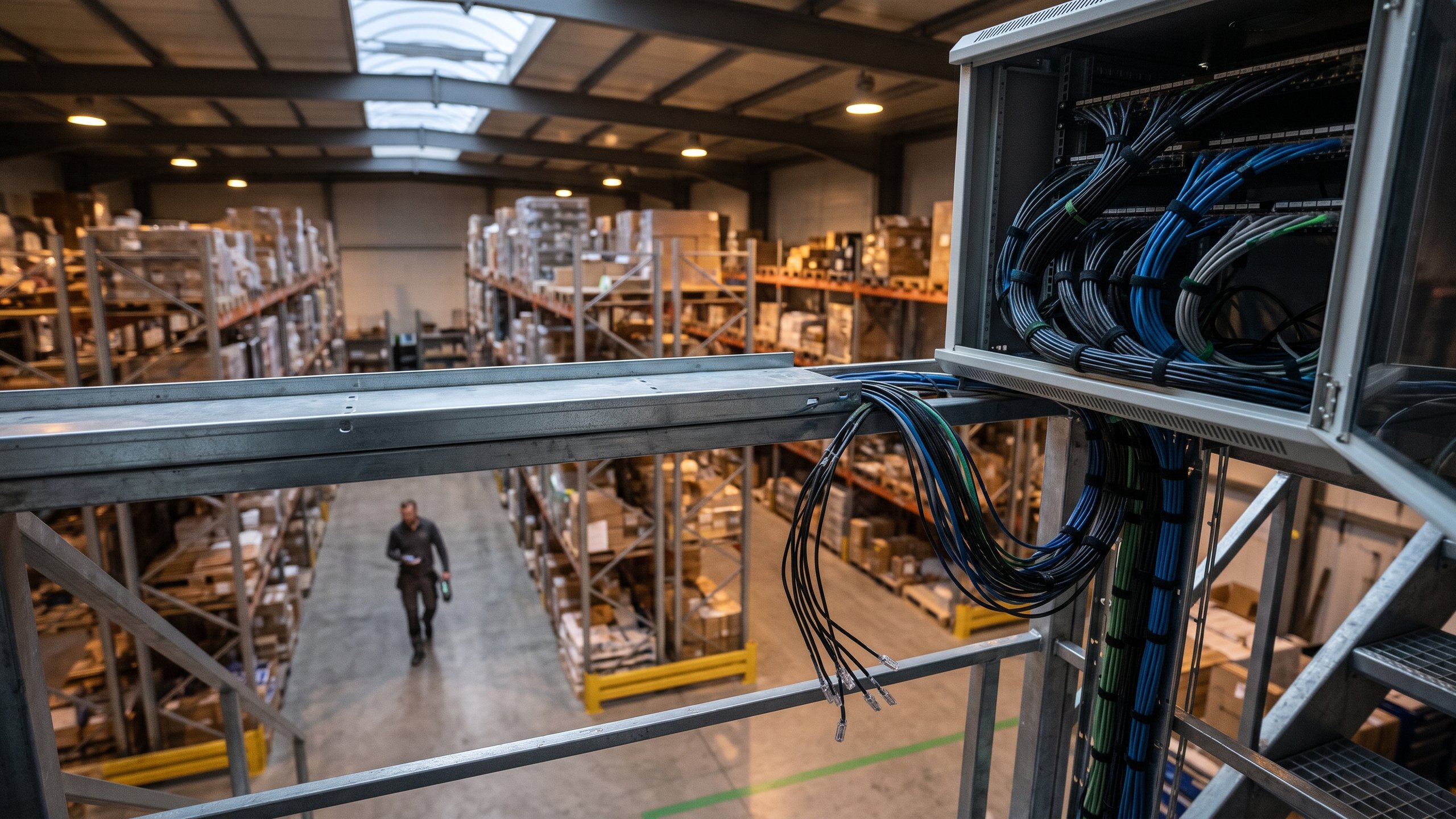
Companies that part ways with their WMS vendor rarely got stuck because of the license. They got stuck during selection: requirements written by the vendor, custom code instead of configuration, interfaces nobody owns and a contract with no price for change. This guide shows where lock‑in is built, how to check for it before you sign, and when a new warehouse management system is not the project you need.
Where does WMS lock‑in actually come from?
Lock‑in comes from decisions made during selection and contracting, not from the technology itself. A license can be terminated with a notice period. Custom code, warehouse data in a proprietary structure and interfaces that only the vendor understands cannot be terminated; they have to be rebuilt.
That is why lock‑in tends to surface three to five years after go‑live, not during the project. It shows up when you need an upgrade and the vendor quotes months of work to carry your modifications across, when you open a second warehouse and the license model makes it more expensive than planned, or when you add automation and find that the integration layer belongs to someone else.
One of our clients, the packaging manufacturer Servisbal Obaly, went through this the hard way. The first attempt to implement a new warehouse management system ended with the company and its original vendor going separate ways. The second selection, which we facilitated, started somewhere else entirely: with the logistics processes and the requirements derived from them, and only then with vendors. Five solutions were compared against the same criteria, a pre‑implementation analysis named the risks to watch during rollout, and the selected system now runs in operation.
Is a new WMS the answer at all?
Not always. Before writing a single requirement, check whether the problem is the system or the way the warehouse works. A WMS laid over a crooked process does not straighten it; it fixes it in place and makes it harder to change. We described what that looks like after go‑live in ERP and WMS Go‑Live: What Actually Breaks on the Planning Side.
In practice there are usually two main routes, and a company should pick one of them as the main path:
- Fix the operation first. Reorganize work in the warehouse, slotting and material flows, and keep the current system, possibly with an upgrade. This makes sense when the system does what it should and the losses come from how people and equipment are used.
- Replace the system. A new WMS brings many process changes with it, because it enforces locations, scanning and task logic. Running a large optimization project and a WMS replacement in full at the same time usually means doing part of the work twice.
An audit that maps the real material flows answers which route fits. In a project for a multi‑site manufacturer of home and garden products, the logistics audit ended with seven prioritized action plans. Some of them were quick wins that did not need any new system; others were preconditions for a WMS, such as consistent tracking of warehouse movements and clean data.
When the WMS module in your ERP is enough. One warehouse, standard receiving, put‑away and picking, no automation, modest volumes and an ERP vendor with a credible warehouse module: in that case a separate best‑of‑breed WMS often adds an interface and a second vendor without adding much value. The calculation changes with multiple sites, wave or zone picking, value‑added services, 3PL billing or a plan to automate.
Requirements vendors can’t write for you
The specification has to come from your processes and your data, not from a vendor questionnaire or a generic template. When requirements are written by a vendor, or copied from its brochure, the tender is decided before it starts: the specification fits one product, and every other bid looks like a gap analysis.
The opposite mistake is less obvious and just as expensive. In one tender we saw in 2026, the RFP had been prepared by an external administrator with the help of AI. It was extremely detailed and asked for functions that required movement data between locations and buildings, while the company only tracked goods in and out of each warehouse. Vendors could either price everything, which pushed the bids far beyond the budget, or answer selectively, which made the bids impossible to compare. Our recommendation was not to copy the questionnaire literally but to build the scope on practical WMS infrastructure: for simple warehouses, a logical location structure and reliable movement tracking; for outdoor areas, zones; for complex spaces, a more detailed survey.
A usable specification typically contains:
- Key process scenarios described as flows, with volumes and peaks, not as a list of features
- Master data you have today and data you will need, with an owner for each
- Interfaces to ERP, TMS, carriers and automation, including who builds and maintains each one
- Acceptance scenarios: the situations the system must handle before go‑live is approved
- Non‑functional requirements: availability, security, hardware, support hours
This is the part of the project where an independent system specification pays off most, because every later step, from scoring the bids to accepting the system, refers back to it.
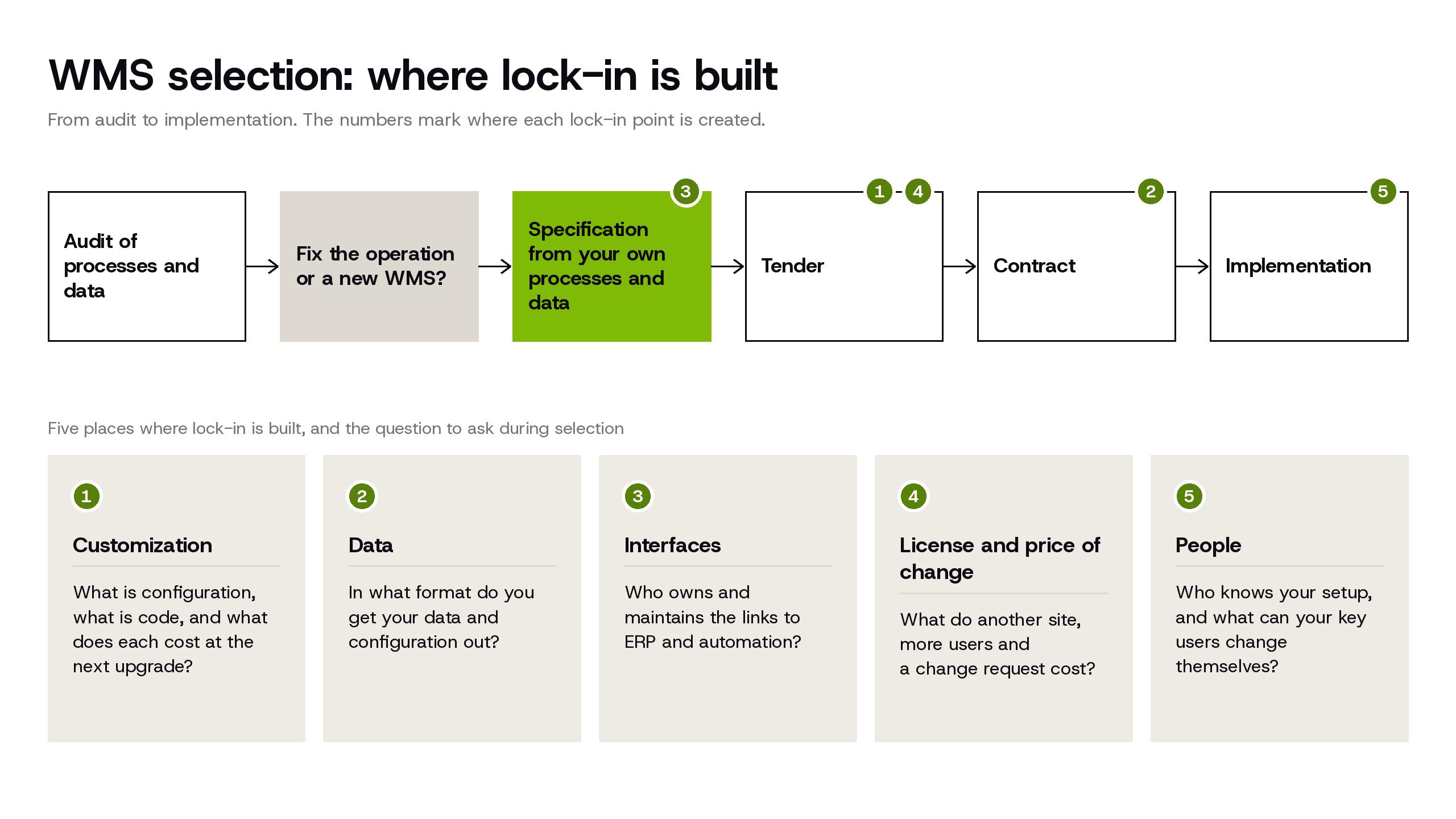
Five places where lock‑in is built
Each of the five has a question you can ask during selection, while you still have negotiating power.
- Customization instead of configuration. Every change made in code rather than in settings has to be carried through every upgrade. Ask each vendor to mark which of your requirements it covers by configuration, which by extension through a supported interface, and which by custom code, and what each category costs at the next major release.
- Data. Who owns the warehouse data, in what format you get it out, and who maintains documentation of the configuration. Without that documentation, a new vendor starts from scratch even if the data export works.
- Interfaces. The connection to ERP, transport management and automation is often the most fragile part of the solution. Decide in advance who builds and owns each interface. In our projects the ERP side is usually delivered by the customer or its ERP vendor, and that split has to be written into the contract, not assumed.
- License model and the price of change. Ask for the price of an additional warehouse, users and modules, and for a rate card for change requests. A low entry price with an open‑ended change budget is the most common way bids are won.
- People. If the knowledge of your setup sits with one consultant at the vendor, you depend on that person’s availability. Ask who will be on the project, who covers support after go‑live, and how much of the setup your own key users will be able to change themselves.
WMS and automation: who controls the material flow?
With automation, a layer appears between the WMS and the equipment: warehouse control or execution software (WCS or WES) that directs conveyors, shuttles, robots and AS/RS. This is where lock‑in is most often created, because automation suppliers like to offer their own WMS or their own control layer as part of the package.
There are two clean ways to handle it. Either select the WMS and the automation separately with a clearly specified interface between them, or tender them together with one party responsible for the performance of the whole flow during ramp‑up. The unclear middle, where the WMS vendor blames the automation for missed throughput and the automation supplier blames the WMS, is the scenario to avoid in the contract.
For Plzeňský Prazdroj we managed the tender for the technology suppliers of a high‑bay warehouse with 42,000 pallet positions and coordinated technology, IT, construction and fire safety through to go‑live. For Rohlik, the integration of AutoStore, including Europe’s first refrigerated AutoStore zone, was delivered in ten months instead of the one to two years typical for such projects. In the Rohlik project, managing that integration was the core of the work. If automation is on your roadmap, build the business case for it before you select the WMS, so the WMS is chosen for the warehouse you will run, not the one you have today.
Comparing bids on five‑year cost, not license price
Compare bids on total cost of ownership over at least five years: license or subscription, implementation, interfaces, hardware, support and expected changes. The first price on the cover page says little about what the system will cost to run. A good practice we saw in a 2026 tender was a price sheet with five‑year TCO included directly in the tender documents, so every vendor had to fill in the same structure.
Three more rules make bids comparable:
- Demos on your scenarios and your data, not the vendor’s standard presentation. Give every vendor the same three or four process scenarios from the specification and watch them run.
- References from similar operations. A WMS that works well for a single‑site e‑commerce warehouse tells you little about a manufacturer supplying production lines from two buildings.
- Scoring weights agreed before the bids arrive. If price, functional fit, vendor stability and implementation approach are weighted after opening the bids, the weights tend to follow the favorite.
We plan selections as a single round with one evaluation; a further round of offers (best and final offer) is useful only when two bids are genuinely close. Each extra round adds weeks and gives the vendors time to reprice. Independent tendering keeps that process transparent for both sides.
What the contract has to say before you sign
The contract is where the five lock‑in points from the earlier section either get closed or stay open. Before signing, check that it states:
- Data export and exit: format, scope and cost of handing over your data and configuration if the cooperation ends
- Configuration documentation: delivered and kept up to date as part of the scope
- Interface ownership: who builds, tests and maintains each interface, and who pays when the other side changes
- Rate card and change process: daily rates and the approval process for change requests during and after implementation
- Acceptance criteria: go‑live approved only after the acceptance scenarios from the specification pass, not on a fixed date
- Support and SLA: response times by priority, and what happens during peak season
A contract cannot rescue a system that does not fit the operation. It protects you from the consequences of a good choice that later needs to change.
When a full tender is overkill
A formal tender is not always worth the effort. For a single warehouse with standard processes and no automation plans, a shortlist of two or three candidates, demos on your own scenarios and a careful contract review are often enough.
When a full selection does make sense, plan for it realistically. In our projects, a functional specification takes about three weeks and a tender roughly another three, both running after an audit of processes and data. Including the audit, the path from first workshop to a recommended vendor typically takes around three months. That is shorter than the delay caused by restarting a failed implementation, which is the situation Servisbal found itself in before its second selection.
If you are about to choose a WMS for 2027, the decisions with the longest consequences fall in the first weeks: whether you need a new system at all, who writes the requirements, and what the contract says about change. Those are also the cheapest to get right.
Frequently asked questions
After an audit of processes and data, a functional specification takes about three weeks and the tender about three more. Including the audit, expect around three months from the first workshop to a recommended vendor. Implementation follows and depends on the scope and the number of sites.
Often yes for a single warehouse with standard processes, moderate volumes and no automation. A separate WMS starts to pay off with multiple sites, complex picking, value‑added services, 3PL billing or automation, where a dedicated system handles the logic better than a general ERP module.
Yes, but it is expensive, because part of the work has to be redone. Before switching, check what you can take with you: process documentation, specification, master data and test scenarios. If those were prepared independently of the vendor, the restart is much faster.
Every interface needs one named owner responsible for building, testing and maintaining it. The ERP side is usually delivered by the customer or its ERP vendor. The split has to be written into the contracts with all parties, otherwise each vendor will treat the interface as someone else’s responsibility.
From our projects

WMS selection and rollout for Servisbal
From a halted WMS project to a live system. Clear requirements, disciplined vendor selection, and hands‑on support enabled a stable rollout.
Successful vendor selection
Clear requirements and risk control
Contracting without friction

Logistics audit and digitalization roadmap for AGRO CS
A comprehensive logistics audit that replaced manual, paper‑based processes with a clear digitalization roadmap, enabling higher transparency and faster expedition.
Digitalizing logistics for scalable growth
Turning data into a strategic roadmap
More supply chain insights
Supply chain glossary
Distribution Network Optimization
What distribution network optimization is, which costs it trades off and why more warehouses mean more safety stock.
25. november 2026
2 min
Supply chain glossary
Hub‑and‑Spoke
What a hub‑and‑spoke network is, why consolidating flows through a hub fills vehicles, and when a lane should go direct instead.
24. november 2026
2 min
Supply chain glossary
Milk Run
What a milk run is, how a fixed collection route differs from direct deliveries, and why its main benefit is smaller, more frequent shipments.
23. november 2026
3 min