Whitepapers & ebooks
Warehouse Automation ROI: How to Build the Business Case Before You Invest
What automation really costs, where the return actually comes from, and how to build a business case that survives contact with your CFO — including when not to invest.
30. july 2026
8 min
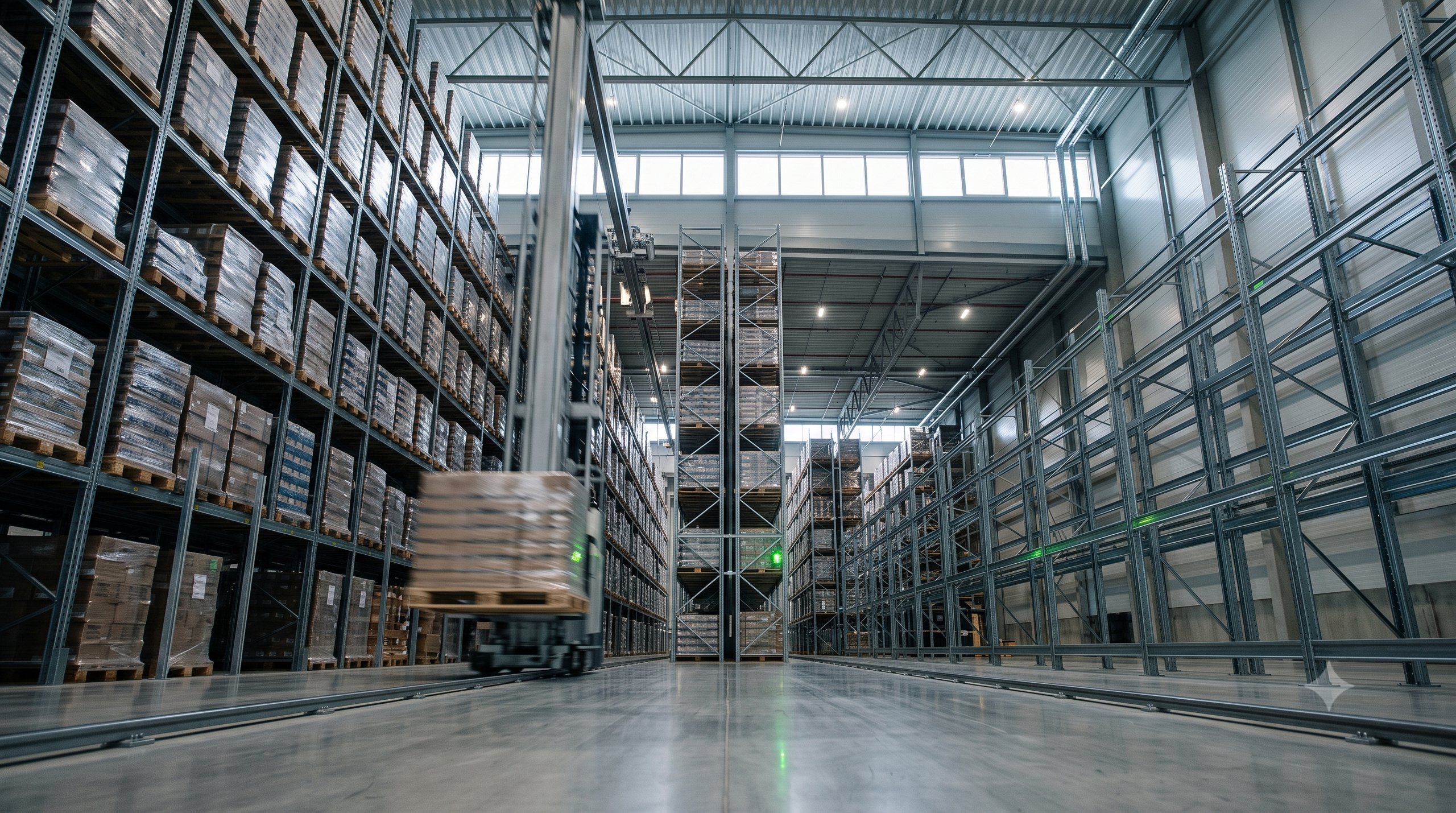
Warehouse automation is often the largest single logistics investment a company ever makes — and the business case behind it is usually built on the vendor's numbers, not yours. This guide breaks down what automation really costs, where the return actually comes from, and how to build a business case that survives contact with your CFO.
Why do warehouse automation business cases so often overpromise?
Most automation business cases overpromise because they are written by the party selling the technology. A vendor's calculation assumes ideal utilization, a smooth ramp‑up, and a warehouse that behaves like the reference site in the brochure. Your warehouse won't.
The track record of large capital projects shows how expensive that optimism is. McKinsey's review of more than 300 billion‑dollar‑plus projects found average cost overruns of roughly 80% and schedule delays of about 50%. An earlier McKinsey analysis put it even more bluntly: 98% of megaprojects run more than 30% over budget. Warehouse automation projects are smaller, but they share the same anatomy — long lead times, deep integration into existing operations, and a business case locked in before the messy details surface.
The pattern is structural, not moral. A technology supplier is paid to install a system, not to guarantee your throughput three years from now. The assumptions that decide ROI — order profile, seasonality, growth curve, labor availability — sit on your side of the table. If you don't model them yourself, someone with a sales target will model them for you.
What does warehouse automation actually cost?
The price tag on the automation technology is typically only 60–80% of the total investment — the rest hides in everything around it. A realistic total cost of ownership has four layers:
- Technology CAPEX: the AS/RS, shuttles, conveyors, AMRs or sorters themselves — the number on the vendor's quote.
- Building and infrastructure readiness: floor flatness, fire protection, power capacity, network coverage. These items are rarely in the vendor quote and routinely surface after contract signature.
- IT integration: connecting the system to your WMS and ERP, testing exception flows, and cleaning master data that suddenly has to be accurate. Integration effort is the most commonly underestimated line item in the projects we see.
- Ramp‑up losses: the months between go‑live and stable target performance, when throughput is below plan and manual backup processes run in parallel.
On top of CAPEX, count recurring operating costs — maintenance contracts, spare parts, software licenses, and specialized technicians. A common planning rule of thumb is 5–8% of the initial technology investment per year. Over a ten‑year horizon, that alone can add half the original CAPEX again.
This is why disciplined project delivery and execution matters as much as technology selection: most of the cost surprises are management failures, not engineering ones.
Where does the ROI actually come from?
Automation pays back through four levers, and every serious business case should quantify each one separately:
1. Labor productivity. The strongest and most measurable lever. When Logio designed a phased automation strategy for a major French e‑grocery operation, picking productivity increased by 400%. The lever is getting stronger every year: Eurostat data shows labour costs in transportation and storage growing 9.1% year‑on‑year in Czechia, 10.6% in Poland and 8.3% in Slovakia — several times the euro‑area average. Every percent of wage inflation shortens your payback.
2. Storage density. Automated high‑bay systems store more in the same footprint. The automated warehouse Logio delivered for Plzeňský Prazdroj fits 42,000 pallet positions into a fully automated AS/RS — capacity that would otherwise require new construction and land.
3. Accuracy and error cost. Mispicks, damaged goods and inventory write‑offs are quiet losses that rarely appear in P&L discussions but add up to real money. Automated systems typically push picking accuracy above 99.9%, and the savings compound in fewer returns, fewer claims and less safety stock.
4. Peak scalability. A manual warehouse scales with temporary labor — increasingly scarce and expensive during exactly the peaks when you need it. An automated system absorbs seasonal spikes without recruitment. The e‑grocery design above was laid out for 5x capacity growth for this reason.
A business case that lumps these levers into one “efficiency” number can't be stress‑tested. Keep them separate, and be honest about which ones apply to your operation — a low‑error, low‑density warehouse won't earn returns from levers two and three.
How long is a realistic payback period?
For most full‑scale warehouse automation projects, a realistic payback period is three to five years; lighter deployments such as AMR fleets can pay back in under two. Anyone promising a full AS/RS installation pays for itself in eighteen months is either describing an extreme labor‑cost scenario or selling something.
The single biggest driver of payback is utilization. An automated warehouse is a fixed‑cost machine: it earns its return only when volume flows through it. At 85% utilization the numbers work; at 50% the same system is the most expensive warehouse you have ever operated. This cuts both ways — undersizing kills service levels, oversizing kills ROI. That is exactly why the sizing decision should come from a simulation of your own order data, not from a vendor's capacity table.
The second driver is wage development. At Central European labour‑cost growth rates of 8–10% per year, a business case that looks marginal today can turn solidly positive within two budget cycles — a sensitivity worth modeling explicitly rather than discovering by accident.
When does automation NOT pay off?
Automation does not pay off when volumes are low, demand is unpredictable, or the operation is about to change shape. Concretely, walk away — or wait — when:
- Volumes don't fill the machine. If your realistic mid‑case volume leaves an automated system below ~60% utilization, fixed costs will eat the labor savings.
- Your assortment is unstable. Highly variable product dimensions, short product lifecycles or frequent network redesigns punish rigid systems. Flexible automation (AMRs, goods‑to‑person) tolerates change better than monolithic AS/RS — at a different price point.
- The site itself is uncertain. A lease expiring in four years or a possible network consolidation makes a ten‑year asset the wrong answer, whatever the spreadsheet says.
- The process is broken. Automating a badly designed process gives you a faster version of the same problem. Layout and process redesign often deliver a large share of the benefit at a fraction of the cost — Logio's layout optimization for SIGMA Group freed up 1,330 m² of production and warehouse space with no automation hardware at all.
A technology vendor has no commercial reason to tell you any of this. An independent consultant does — which is why the “when not to” chapter belongs in every honest business case, and why we insist on writing it.
How do you build a business case the CFO will trust?
A credible automation business case is built on your data, run through scenarios, and stress‑tested before anyone talks to a vendor. The sequence that works:
- Start from your own flows. Twelve months of order lines, SKU dimensions, seasonality curves. This dataset — not a benchmark — defines what any system will actually do in your building.
- Simulate before you specify. A warehouse simulation of your real order profile against candidate designs turns vendor claims into testable numbers, and typically kills at least one attractive‑looking option.
- Model scenarios, not a point estimate. Base, growth and downside volumes. If the case only works in the growth scenario, the board should know that before approving it.
- Run the sensitivities that hurt. Utilization, wage growth, ramp‑up duration, energy prices. The goal is to know which assumption breaks the case first.
- Plan the execution governance. The McKinsey overrun statistics above are mostly failures of project management, not technology. Budget for integration, ramp‑up and a realistic timeline — and assign clear ownership for each. Sometimes the honest first step isn't automation at all but a structured audit: Logio's logistics audit for AGRO CS replaced paper‑based processes with a digitalization roadmap that made a later automation decision an informed one.
Done this way, the business case stops being a sales document and becomes what it should be: a decision instrument the CFO can defend to the board — including the option of not investing yet.
FAQ
How much does warehouse automation cost for a mid‑size operation? Anywhere from the low hundreds of thousands of euros for an AMR pilot to tens of millions for a fully automated high‑bay warehouse. More useful than a range: expect the technology quote to represent only 60–80% of total project cost once infrastructure, IT integration and ramp‑up are included.
What payback period should I expect? Three to five years for full‑scale automation, under two for light AMR deployments in high‑labor‑cost operations. Payback is driven mainly by utilization and local wage development — both worth modeling as sensitivities, not constants.
Should I automate if labor is still affordable in my region? Run the numbers with wage growth included, not today's rates. Labour costs in Central European logistics are growing 8–10% per year (Eurostat), so a case that is marginal at current wages may be clearly positive over the investment horizon. If it still isn't, don't automate — improve process and layout first.
What's the biggest risk in a warehouse automation project? An oversized or undersized system, caused by building the business case on vendor assumptions instead of your own order data. The second biggest: underestimating IT integration and ramp‑up, which drive most schedule and budget overruns.
Thinking about automation? Test the business case before you sign it. Logio runs independent, simulation‑based assessments of warehouse automation investments — from data analysis to a board‑ready business case. Talk to an Expert.
More supply chain insights

Infographics
10 pumpkin facts you didn’t know: from field to warehouse to Halloween
A pumpkin is botanically a fruit, it is 90% water and it sells for only a few weeks a year. For logistics, that means heavy, fragile cargo with a low value per kilo. Here are ten things you may not know about it.
26. october 2026
4 min
Supply chain glossary
Integrated Business Planning (IBP)
What integrated business planning is, which steps it adds to S&OP, and why a plan that holds in units can still miss the budget.
25. october 2026
3 min
Supply chain glossary
Master Production Schedule (MPS)
What a master production schedule is, how time fences limit changes to it, and what changeovers cost when the schedule is cut too fine.
25. october 2026
3 min