Whitepapers & ebooks
Automated Replenishment: What Has to Be True Before It Works
Four things decided before go‑live determine whether automated replenishment works. A readiness checklist from our projects, including when not to automate.
03. november 2026
11 min
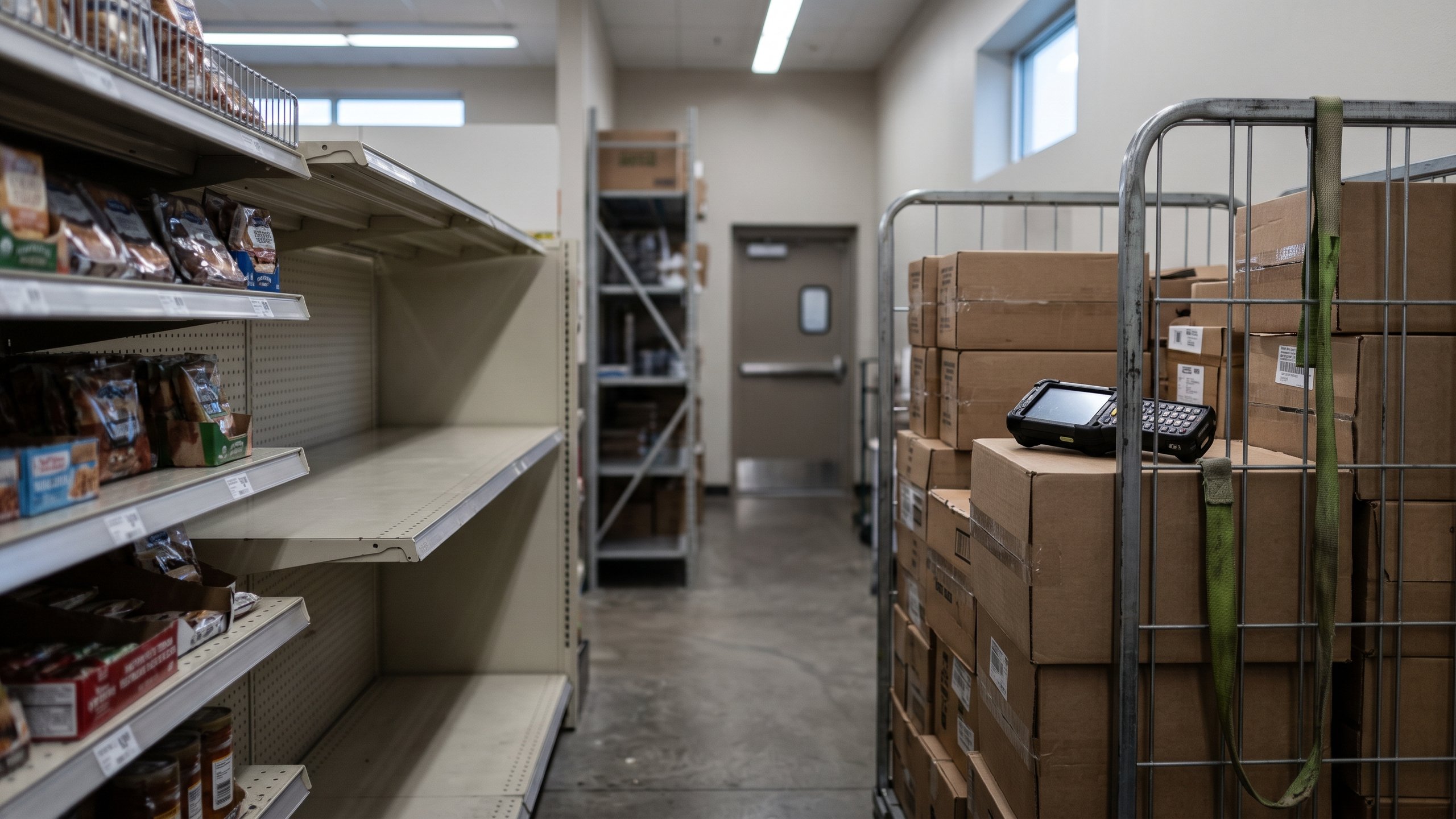
Automated replenishment rarely fails because of the algorithm. It fails on four things that are decided before go‑live: how accurate the stock records are, whether master data matches reality, who is allowed to override the system, and who owns the exceptions. This is the checklist we use on projects, including the situations where we advise against automating at all.
What does automated replenishment actually decide?
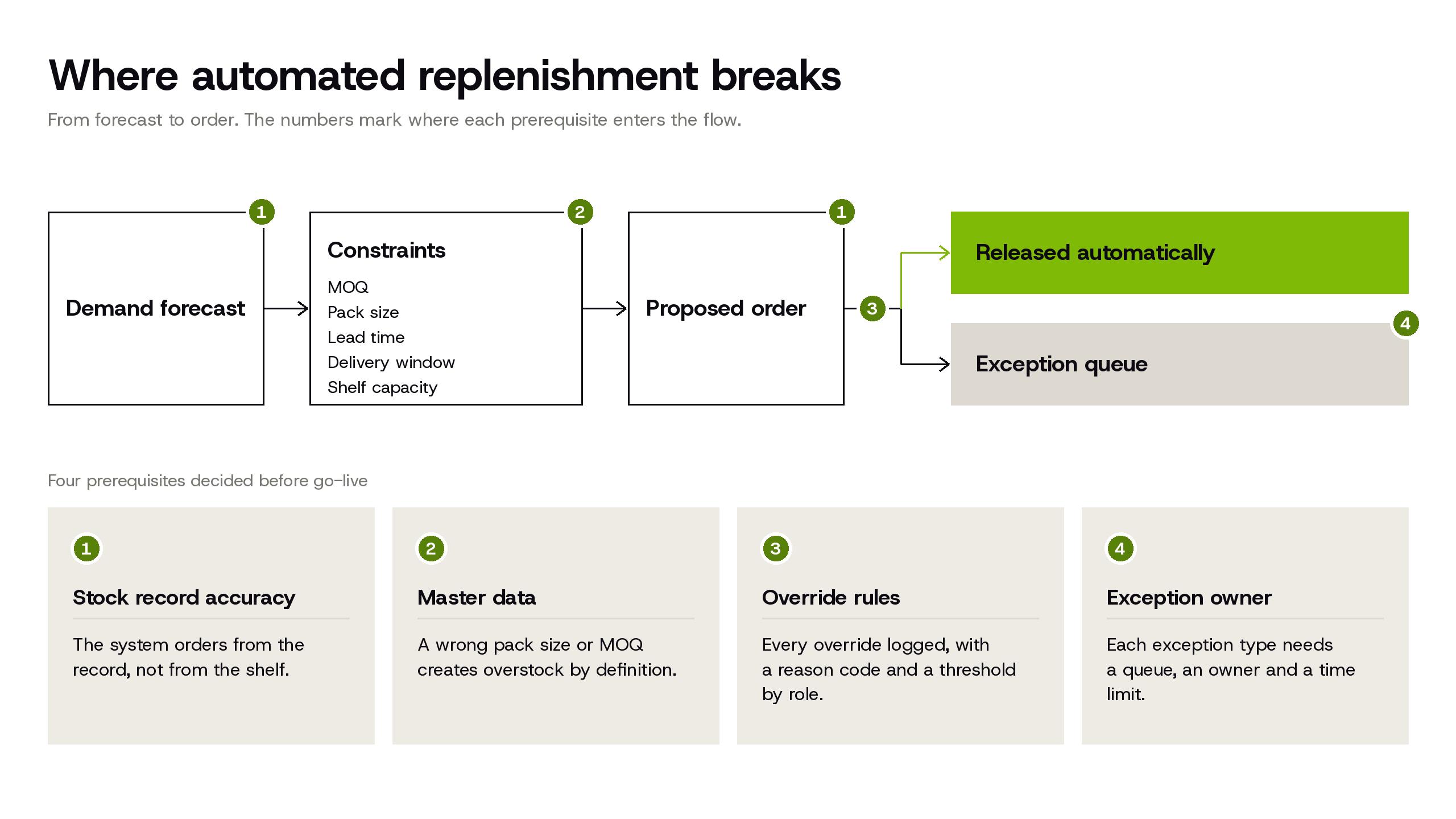
An automated replenishment system turns a demand forecast into a specific order for every item and location. It works out how much to order and when, and it respects the constraints that make an order executable: minimum order quantity, pack and pallet size, supplier lead time, delivery windows, and the space available on the shelf or in the warehouse slot.
That is the difference from the reorder point most ERP systems offer. A static reorder point triggers an order when stock falls below a fixed level. It does not know that demand on Friday is twice the demand on Tuesday, that the supplier delivers only on Mondays, or that the shelf holds 24 units and the case contains 36. So it produces one of two outcomes, depending on how the level was set: regular stockouts, or a back room full of stock that will not fit on the shelf.
What the system does not take over is responsibility. It will calculate a correct order on top of a wrong stock figure, a wrong pack size or a planner's override, and it will do so for thousands of items every night. Everything that follows in this guide is about the inputs and decisions that stay with people. If you want the longer argument about why a better forecast alone does not raise availability, we made it in a separate piece on forecasting and execution. Here we start one step later: you have decided to automate store replenishment, and you want to know whether the operation is ready for it.
How accurate are your stock records, really?
Automation does not reduce errors in stock records. It amplifies them, because the system orders from the record, not from the shelf.
The best‑known measurement of this problem comes from a study of nearly 370,000 inventory records across 37 stores of one retailer, published by Nicole DeHoratius and Ananth Raman in Management Science in 2008. 65% of the records did not match the physical stock. The more useful finding for anyone preparing a rollout sits further in the paper: 26.4% of the variance in record inaccuracy lay between product categories, and only 2.7% between stores. Where the errors are depends much more on what is being counted than on which store is counting it.
The mechanism that makes this expensive is phantom inventory. The record says there are four units, the shelf is empty, and the system sees no reason to order. The stockout does not resolve itself. It lasts until someone notices the empty shelf and corrects the record, which in a large store can take weeks for a slow‑moving item. A human planner who walks the aisles sometimes catches this. A system running overnight never does.
What we check before go‑live follows directly from the category finding. We audit a sample of records by category, not store by store, and we start with the categories where our experience says errors concentrate: fresh goods, high‑shrink items and multipacks that are sold both as a pack and individually. Alongside the sample audit, two reports tell you a lot quickly: the list of items with negative stock on hand, which is always a record error, and the actual cycle count calendar, compared with the one written in the process manual. This order of categories is a working rule from projects, not a published benchmark, but it has rarely sent us to the wrong place first.
Master data is the actual project
Most of the work on an automated replenishment project is not configuring the model. It is getting the master data right and keeping it right.
A wrong pack size or an outdated minimum order quantity creates overstock by definition. The system calculates correctly, rounds up to the pack or the MOQ it was given, and the result lands in the warehouse. The fields that decide whether orders are executable are well known, and in most companies several of them are incomplete: pack size and pallet configuration, MOQ, lead time per supplier and per distribution centre, delivery windows, shelf capacity or planogram facings, the lifecycle status of each item (new, regular, phasing out), and a calendar of holidays and store closures.
At Albert, which runs more than 300 supermarkets in the Czech Republic, the sequence reflected this. The project started with an assessment of planning and ordering and a definition of shared data requirements. The second step was a data model and integrations that gave commercial and logistics teams a single source of truth. Only then was forecasting configured for regular and promotional demand and linked to replenishment rules.
The part that is easy to skip is ownership. A one‑off clean‑up before go‑live holds for a few months. After that, new items are listed with default values, a supplier changes its pallet format, and nobody updates the field because nobody is responsible for it. Every field that drives an order needs a named owner and a change process, or the data quietly returns to where it was.
Who is allowed to override the system?
If anyone can change a proposed order, without a record and without a threshold, the system becomes a suggestion box and most of its benefit disappears.
The research on forecast adjustments gives a sense of how much is at stake. Robert Fildes, Paul Goodwin and Shari De Baets analysed around 147,000 forecasts from six studies using a common framework, published in the International Journal of Forecasting in 2024. Judgmental adjustments improved bias and accuracy for only just over half of the items. Upward adjustments were more likely to make the forecast worse, while large downward adjustments typically improved it. The evidence that planners were using information the algorithm did not have was weak. They appeared to react to irrelevant cues or to ones with little diagnostic value.
The same pattern applies to orders, with an extra cost. When a planner rounds an order up “to be safe”, the override also bypasses the constraints the system respected: the shelf capacity, the delivery window, the pack size. The extra stock does not only sit in the calculation. It sits in the back room.
This does not mean overrides should be banned. It means they need rules. Three things work in practice: a log of every override with a reason code, thresholds by role (a store manager can adjust within a band, larger changes go to the central team), and a regular review of whether overrides added value, using the same forecast value added logic applied to orders instead of forecasts. The useful distinction is between two kinds of override. “I know something the system does not” is legitimate: a new listing with no history, a known supply problem, a local event. “I do not trust the number” is a signal to fix the input, not to change the output.
Someone has to own the exceptions
The goal of automation is not zero human touches. It is few touches, in the right places, handled by someone whose job it is.
An exception is any order the system cannot or should not release on its own: an order suppressed by a capacity limit, a supplier that did not deliver, a promotion overlapping with a seasonal peak, a new item without history, a store that has hit its storage ceiling. Each type needs a queue, an owner and a time limit. Without that, exceptions pile up in an inbox nobody opens, and the planners go back to building orders by hand because it feels safer.
At Košík.cz, the online grocer, product availability reached 97% and waste fell by 75% after Veritico STOCK went live alongside redesigned ordering and warehouse processes. Tomáš Jeřábek, the company's CEO, describes the effect this way: after a few weeks, the average daily write‑off value for expired goods fell to a quarter. The case study also records less manual effort in ordering. That effort did not vanish. It moved from building orders to handling the items that genuinely needed a decision.
The number worth tracking from the first week is the touch rate: the share of proposed orders a person opens before release. A high touch rate that does not fall after the first month usually means one of the earlier prerequisites is missing, most often trust in the stock records.
What does a sensible rollout look like?
A sensible rollout starts with a pilot on a slice of the assortment and a group of locations, runs in parallel with the existing process for a period, and ends with acceptance criteria agreed before it starts.
The Albert project followed four stages that we would recommend to most retailers and distributors: assess current planning and define data requirements, design the data model and integrations, configure forecasting and replenishment rules, and operate and harden the system through volatile periods before extending it. The last stage is the one that gets cut when budgets are tight, and it is the one that tells you whether the system holds up.
Seasonality decides how long a pilot needs to run. Pompo, a Czech toy retailer with more than 100 stores, a wholesale business and an e‑shop, improved product availability by 3% across a highly seasonal assortment where Christmas dominates the year. A pilot that ends in October would say almost nothing about how the system handles the weeks that matter most. Acceptance criteria should be written for the period in which the business actually makes or loses its year.
In mid‑size companies in Czechia and Slovakia, what slows a pilot down is rarely the vendor. It is capacity on the client side. Two decisions make the difference: a person dedicated to master data for the duration of the pilot, not borrowed from another team for a few hours a week, and an agreed override policy before the first order is released. Without them, the pilot runs, but nobody can say at the end whether the results came from the system or from the planners working around it. The same applies to the upstream flow: if the distribution centre orders from suppliers by hand while stores are automated, the gains stop at the DC door, which is why DC replenishment and supplier ordering usually belong in the same plan, even if they go live later.
When not to automate replenishment
There are four situations in which we advise against automating, even when the client wants to.
- Less than a full seasonal cycle of history for a large part of the assortment. Our threshold is at least one complete seasonal cycle, which in practice means 12 months. Below that, the model cannot separate seasonality from trend, and every peak looks like growth. This is our working rule, not an external standard. A new business or a completely replaced assortment usually needs a different approach until the history exists.
- An assortment that turns over so fast the model has nothing to learn from. Fashion‑like ranges, where most items live for one season, need attribute‑based forecasting and allocation, not classic replenishment.
- No owner for master data. Without one, automation drifts back to manual mode within a few months, and the company ends up paying for a system its planners work around.
- An ERP or WMS change within the next twelve months. Do the system layer first and replenishment second. The reverse order means building the integrations twice and running the pilot on data that is about to change. We described what breaks on the planning side during such a change in our guide to ERP and WMS go‑live.
One more boundary applies to part of the assortment rather than the whole project. For items with very intermittent demand, such as spare parts or the long tail of a hardware range, a simple min/max rule with a periodic human review is often cheaper and more stable than full automation. Automating everything is not the goal. Automating the items where the system decides better than a person is.
Four numbers to measure before you sign anything
Four numbers say more about a project's chances than any comparison of vendor features:
- Stock record accuracy by category, from a sample audit, with the worst three categories named.
- Completeness of order‑driving master data, as the percentage of active items with every field from the list above filled and verified.
- The share of orders overridden by hand today, and in which direction.
- The weekly volume of exceptions the current process already handles, whether anyone calls them that or not.
If the first two are weak, fix them before the pilot starts. If the third is high, agree the override policy before go‑live. If nobody can produce the fourth, the exception queue does not have an owner yet. Once these four are known, testing a tool on your own data becomes meaningful, and we described how to do that in our guide to choosing and testing inventory optimization software.
Frequently asked questions
At least one complete seasonal cycle, which for most retailers and distributors means 12 months. With less, the model cannot tell seasonal peaks from growth. Items with shorter history can still be included, but they need rules for new items and closer review until the history builds up.
For store replenishment, yes, as long as store stock records are reliable and the supplier or distribution centre can execute the orders. For warehouse and DC replenishment, the system needs accurate stock and location data, which in practice usually comes from a WMS. Without it, the accuracy of the warehouse record becomes the first thing to fix.
A replenishment system needs a promotional forecast as an input, not only the baseline. When promotions are planned in a separate spreadsheet, the replenishment system sees the uplift only after sales start. Linking promotion planning to replenishment is what lets stock arrive before the promotion instead of during it.
Yes, but they do different work. Instead of building orders item by item, they handle exceptions, maintain the rules and the data behind them, and decide the cases where they know something the system does not. Teams that plan for this change keep their best planners. Teams that do not often see those planners override the system to stay useful.
From our projects

Automated replenishment for MILK‑AGRO
MILK‑AGRO automated store replenishment with Veritico STOCK, lifted on‑shelf availability above 98 percent, and stabilized inventory with less manual effort.
98%+ service level in stores
Improved inventory turnover.
Lower losses from expiration and revaluation.

Inventory optimization for GGT
Automated forecasting and replenishment across 800+ branches delivered higher sales, leaner stock and faster ordering.
+5% revenue
–15% stock
–60% time to create orders
More supply chain insights
Supply chain glossary
Cross‑Docking
What cross‑docking is, how pre‑allocated and post‑allocated variants differ, and why it moves safety stock from the distribution center to the stores.
19. november 2026
3 min

Whitepapers & ebooks
Vendor‑Managed Inventory: When Handing Replenishment to the Supplier Pays Off, and When It Backfires
Vendor‑managed inventory moves ordering to the supplier but does not remove stock from the chain on its own. When VMI pays off for a retailer, when it backfires, and what to settle before signing.
19. november 2026
10 min

Supply chain glossary
Slotting
What warehouse slotting is, why items are ranked by pick lines rather than units sold, and how location size sets the number of replenishment trips.
18. november 2026
3 min