Whitepapers & ebooks
Vendor‑Managed Inventory: When Handing Replenishment to the Supplier Pays Off, and When It Backfires
Vendor‑managed inventory moves ordering to the supplier but does not remove stock from the chain on its own. When VMI pays off for a retailer, when it backfires, and what to settle before signing.
19. november 2026
10 min

Vendor‑managed inventory moves the ordering decision to the supplier, but it does not take stock out of the chain on its own. It pays off where the supplier sees demand better than the retailer does and where the agreement measures availability on the shelf rather than volume delivered to the warehouse. This guide covers when that holds, when VMI only pushes stock one step up the chain, and what both sides need to settle before they sign.
What actually changes when the supplier takes over replenishment?
The decision changes hands; the physics of the supply chain does not. Under vendor‑managed inventory (VMI), the supplier decides what to ship and when, based on stock and sales data the retailer shares. Demand stays the same, and so do the lead time, the pack size and the minimum order quantity (MOQ). If none of those move, the only thing VMI changes is who sits at the spreadsheet.
VMI can create value in three ways, and it is worth checking each one before signing:
- Better demand signal. A supplier that sees daily sell‑out and stock per location forecasts real demand instead of guessing the retailer’s ordering habits. That dampens the bullwhip effect upstream.
- One planning layer instead of two. When the retailer stops planning the item, its own safety buffer for planning errors can go too.
- Smoother physical flow. A supplier that plans the whole account can ship smaller, more frequent deliveries, or consolidate them into fuller trucks.
The research is blunt about which of these matters most. Cachon and Fisher compared a supply chain with full information sharing against one with traditional ordering. Sharing information lowered supply chain costs by 2.2% on average and by 12.1% at most. Cutting lead times nearly in half reduced costs by 21% on average, and cutting batches in half by 22% (Management Science, 2000). The data feed is the easy part of VMI to buy. The savings come only if the supplier uses it to change how goods move.
When does VMI pay off for a retailer?
VMI pays off when the supplier can plan an item better than the retailer, and when that advantage is large enough to cover the cost of connecting the two systems. In practice that narrows the field to a recognizable set of items:
- Stable base demand. Fast‑moving items with little promotional activity, where daily sell‑out tells the supplier almost everything.
- A supplier that plans many accounts. A drinks or household goods manufacturer that sees the same item across several retailers can pool that information. A supplier with one large customer gains little.
- Frequent deliveries to a distribution center (DC). VMI works most naturally where the supplier replenishes a central warehouse several times a week, not where it delivers to hundreds of stores once a month.
- Clean master data. Pack sizes, order multiples and lead times have to match on both sides, or the supplier’s proposals will be wrong before they leave its system.
- A meaningful share of the supplier’s volume. If the account is too small for the supplier to staff properly, VMI becomes a standard report nobody reads.
The opposite profile is just as clear. Seasonal and fashion ranges, items driven by leaflets, new listings and slow movers at a single location are poor candidates. On sporadic items neither side forecasts well, and handing them to the supplier does not change that.
Why does VMI often just move stock one step up the chain?
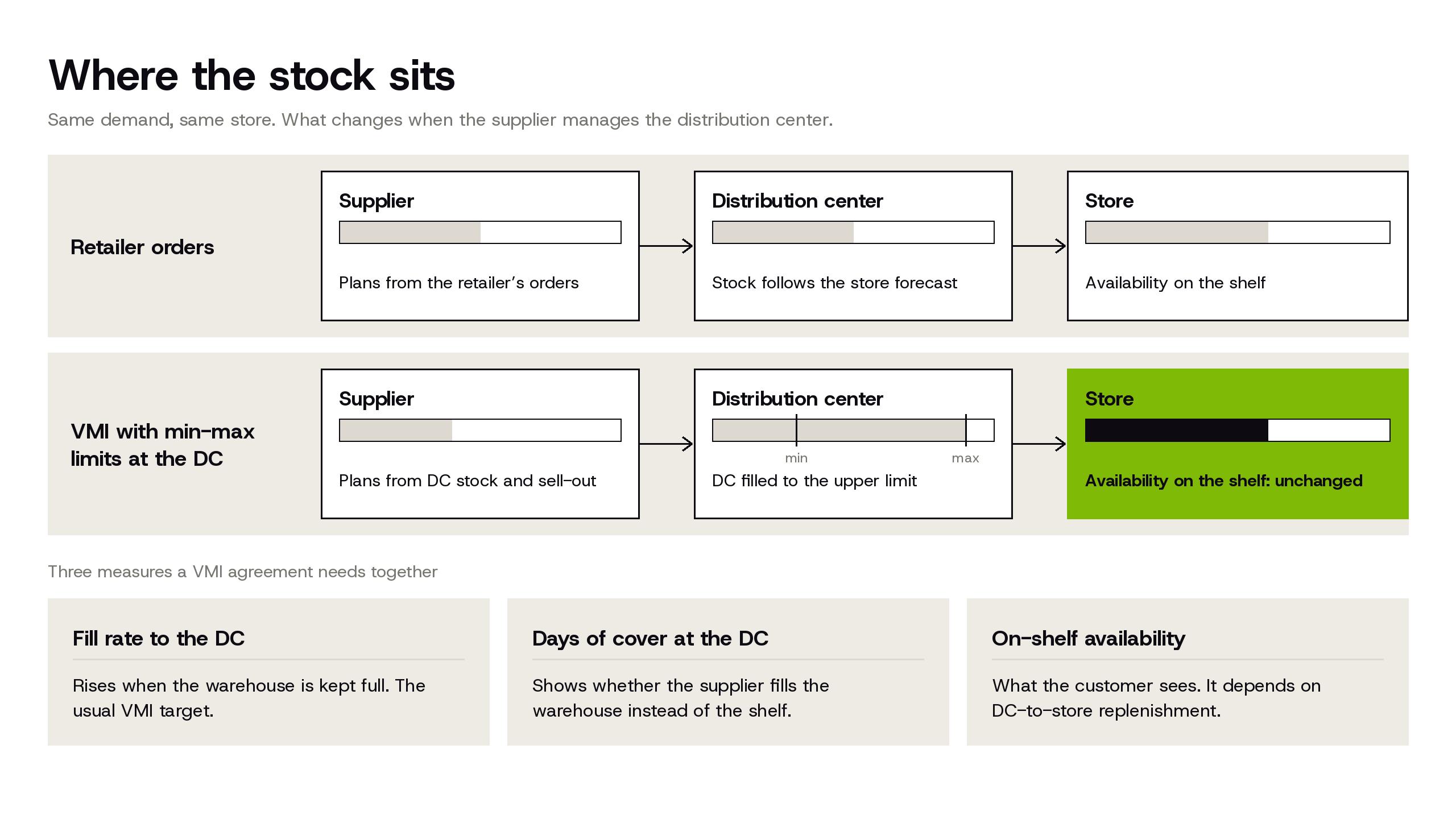
Because the agreement usually measures the wrong thing. A typical VMI contract sets a minimum and maximum stock level at the retailer’s DC and asks the supplier to keep the DC between them at a target fill rate. The supplier, rationally, meets that target by keeping the DC near the top of the range. Fill rate to the DC looks excellent. Product availability on the shelf may not change at all, because shelf availability depends on how the DC replenishes the stores, and VMI does not touch that step.
The second common outcome is that stock moves on paper rather than in the warehouse. When VMI comes bundled with consignment, the supplier owns the goods until they are sold. The retailer’s working capital in inventory falls and the CFO is pleased, but the number of units in the chain is the same. Somebody still finances them, and the cost tends to come back in the purchase price at the next negotiation.
Neither outcome is a reason to avoid VMI. Both are reasons to measure it at the point where the customer meets the product. If the goal is shelf availability, the DC‑to‑store step has to be planned as carefully as the supplier‑to‑DC step. That is the subject of our guide to automated replenishment, and the reason the store replenishment and DC side should be planned from the same forecast.
Promotions, leaflets and listings: where VMI goes blind
VMI breaks down most often on events the retailer plans and the supplier learns about late. A leaflet promotion, a planogram change, a new listing or a delisting all change demand by more than any statistical forecast can anticipate. The retailer knows about them weeks in advance; the supplier often learns about them from the sell‑out data, after the fact.
The typical result follows a pattern. The supplier’s base forecast misses the promotional uplift, so the DC runs short in the first days of the promotion. The supplier then reacts to the spike and ships against the inflated demand, just as the promotion ends and customers who stocked up stop buying. The min‑max range fills to the top with stock that will sell slowly for weeks. If the promotion also took sales from neighboring items, which we cover in our guide to promotion cannibalization, those items carry excess too.
There are two workable fixes. The first is to share the promotion calendar and the expected uplift per item with the supplier in time, as part of the agreement rather than as a courtesy. The second is to keep promotional volumes out of VMI altogether: the supplier replenishes base demand, the retailer orders the promotional quantity separately from its own promotion forecast. As a planning rule of thumb, categories where a large share of volume sells on promotion are better kept under the retailer’s control.
What has to be settled before you sign
Most VMI disappointments trace back to three things that were left vague in the contract: data, limits and measures.
Data. The supplier needs stock on hand and sales per location, every day, in a format its planning system can read. Days when an item was out of stock must be visible as stockouts, not as zero demand, or the forecast will settle below real demand. Data quality matters just as much: phantom inventory, stock that exists in the system but not on the shelf, misleads a supplier’s algorithm exactly as it misleads the retailer’s own.
Limits. Set minimum and maximum levels in days of cover, not in units, so they move with demand. Write down who carries excess stock, who pays for write‑offs of expired stock, and what happens to the stock when an item is delisted or the agreement ends.
Measures. Fill rate to the DC alone rewards overstocking. Pair it with days of cover at the DC and with on‑shelf availability in the stores. A supplier measured on all three has to balance them the way a good planner would. If the retailer already sets service levels and safety stock per item segment, those targets are the natural starting point for the VMI limits.
What ten years of running VMI taught us
One of our clients, a distributor of tobacco and convenience goods, has run VMI for its retail partners on Veritico STOCK for about ten years. Three lessons from that project are worth more than any simulation.
The data connection is the project. VMI was launched together with a new point‑of‑sale (POS) system for the distributor’s retail partners, because the checkout was the only reliable source of daily sales and stock. The distributor decided on the planning system only after it knew how many partners, and which ones, would join.
One partner rarely pays for the investment. When the distributor decided to revive and extend VMI after several years, the first estimate was well above what it had budgeted. The scope was cut to the technical minimum, and the business case only worked if VMI could grow from one retail cooperative to several.
The blocker was not the supplier or the software. The revival stalled for months because some of the retail cooperatives did not want to pay their own ERP vendors for the data export that VMI required. The distributor’s purchasing team ended up negotiating those costs with the retailers’ ERP vendors before the project could start. Every new partner since then has meant a new data connection and new limits, one partner at a time.
For a retailer, the conclusion is practical. Even when the supplier “pays” for VMI, part of the cost sits on the retailer’s side: the export from its ERP, the EDI messages, the master data clean‑up. Put those items into the negotiation before the agreement, not after it.
What does VMI look like from the supplier’s side?
Knowing why a supplier offers VMI helps a retailer judge the offer. For a manufacturer, VMI is worth the effort when it pays off in its own planning: steadier production plans, full truckloads, fewer emergency orders. If it delivers none of that, VMI becomes a free service that the supplier finances with its own stock and staff, and that kind of service rarely gets the attention it needs for long.
Not every supplier wants it. We have also seen a large distributor that asked for VMI for its own customers and, after weighing the options, chose to extend forecasting in its existing ERP instead. VMI is a decision about data and process ownership, and a company can reasonably decide it wants to keep both.
For the retailer this means two things. A supplier that proposes VMI for a narrow, stable part of the range is likely to run it well. A supplier that wants the whole range, including promotional and seasonal items, is likely chasing volume rather than availability.
Alternatives when full VMI does not fit
Between “the retailer orders” and “the supplier decides” there are workable middle grounds:
- VMI for a segment only. Hand the supplier its stable fast movers and keep promotional, seasonal and new items in‑house.
- Shared forecasts without handing over the decision. In collaborative planning, forecasting and replenishment (CPFR), both sides agree on a forecast and the retailer still places the order. In Sari’s simulation, CPFR performed better than VMI in every scenario tested, although the gap did not always justify the extra resources it requires (International Journal of Production Economics, 2008).
- Supplier orders from the retailer’s own forecast. The retailer keeps the decision but calculates orders from store‑level demand rather than from DC stock alone, within the supplier’s constraints. That is how DC replenishment works in Veritico STOCK: lead times, MOQ, order values and pack sizes are built in, and buyers review exceptions instead of recalculating every line.
The choice between these comes down to one question: who sees demand earlier and more accurately, the retailer or the supplier? Where the supplier does, VMI is worth the integration work. Where the retailer does, it is usually cheaper to make the retailer’s own ordering better than to teach a supplier to see what the retailer already knows.
Frequently asked questions
Only if it changes how goods move: smaller batches, more frequent deliveries or a better demand signal. If the supplier simply takes over ordering against the same limits, the stock usually stays the same, and with consignment it only changes owner.
Most of the time goes into the data connection, master data alignment and a trial period in which both sides check the supplier’s proposals. Each additional partner needs its own connection and its own limits, so plan the rollout supplier by supplier rather than as a single project.
Combine fill rate to the distribution center with days of cover at the distribution center and on‑shelf availability in the stores. Fill rate alone rewards a supplier for keeping the warehouse full.
Only if the supplier receives the promotion calendar and the expected uplift per item early enough to plan production and deliveries. Otherwise it is safer to keep promotional quantities out of VMI and order them separately.
From our projects

Smarter promotion mix, leaner leaflets
Veritico PROMO cut the promotional leaflet by 25% with the same sales and lifted promotional profitability.
−25% leaflet size
+1 pp promotional margin at the same sales
+3% profit on promoted items

Promotion planning for Mondelez
Since 2011, Logio helped Mondelez unify planning and raise forecast accuracy from 50% to 70%, improving promotion decisions and cross‑functional alignment.
+20 pp forecast accuracy
Promotion profitability increased
More supply chain insights
Supply chain glossary
Cross‑Docking
What cross‑docking is, how pre‑allocated and post‑allocated variants differ, and why it moves safety stock from the distribution center to the stores.
19. november 2026
3 min
Supply chain glossary
Slotting
What warehouse slotting is, why items are ranked by pick lines rather than units sold, and how location size sets the number of replenishment trips.
18. november 2026
3 min
Supply chain glossary
Order Picking
What order picking is, why the number of lines per order decides between single‑order and batch picking, and why output is measured in lines per hour.
17. november 2026
3 min