Supply chain glossary
Cross‑Docking
What cross‑docking is, how pre‑allocated and post‑allocated variants differ, and why it moves safety stock from the distribution center to the stores.
19. november 2026
3 min
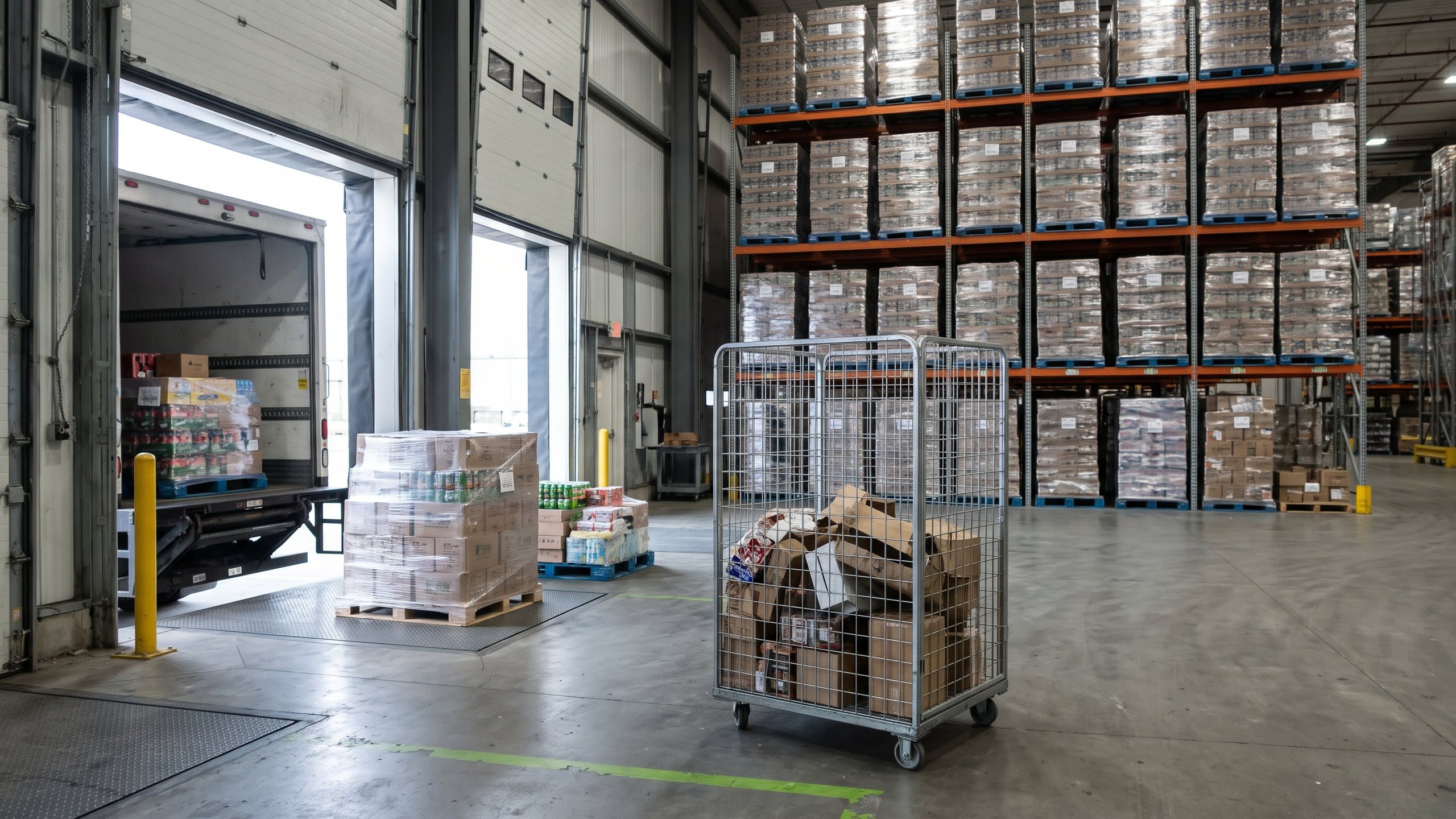
Cross‑docking is a distribution method in which goods arriving at a distribution center are sorted and loaded onto outbound vehicles without being put into storage, usually within hours of arrival. It removes put‑away, storage and picking from the warehouse process, but it only works when the destination of each unit is known before the inbound truck arrives.
There are two basic variants. In pre‑allocated cross‑docking, the supplier already picks and labels the goods per store or customer, and the distribution center (DC) only moves pallets or cases from the inbound to the outbound dock. In post‑allocated cross‑docking, the supplier delivers in bulk and the DC splits the quantity by destination on arrival. The building needs many dock doors and floor space for staging rather than racking, and the warehouse management system (WMS) has to match every inbound delivery to outbound routes.
Cross‑docking in practice
Cross‑docking does not remove inventory, it moves it. In a network with a stocked DC, a store covers demand variability only over the short DC‑to‑store lead time, and the DC covers the supplier lead time once for all stores together. In pre‑allocated cross‑docking, the store quantity is fixed when the supplier ships, so each store has to cover the full supplier lead time on its own. Safety stock grows roughly with the square root of the time it covers: a store that used to cover 1 day and now covers 1 + 7 days needs about √8 ≈ 2.8 times more safety stock, and the pooling of variability across stores in the DC is lost.
That is why the decision is made per item, not for the whole network. Cross‑docking suits items with high and steady demand, where variability is small relative to volume, and fresh products, where every day spent in a DC is a day less of shelf life in the store. Slow movers with irregular demand are better held in the DC, where one buffer serves all stores. The second constraint is timing. Outbound routes wait for inbound trucks, so a supplier who arrives two hours late delays every route that carries its goods, and goods that miss their outbound wave stand on the dock floor, which has no storage locations. Dock doors, staging area and the inbound schedule have to be sized together.
Logio decides which product flows go through cross‑docking and which through stock in distribution concepts and distribution network optimization projects, and tests dock capacity and inbound timing in dynamic simulation before the change goes live.
Related terms
More supply chain insights
Whitepapers & ebooks
Vendor‑Managed Inventory: When Handing Replenishment to the Supplier Pays Off, and When It Backfires
Vendor‑managed inventory moves ordering to the supplier but does not remove stock from the chain on its own. When VMI pays off for a retailer, when it backfires, and what to settle before signing.
19. november 2026
10 min
Supply chain glossary
Slotting
What warehouse slotting is, why items are ranked by pick lines rather than units sold, and how location size sets the number of replenishment trips.
18. november 2026
3 min
Supply chain glossary
Order Picking
What order picking is, why the number of lines per order decides between single‑order and batch picking, and why output is measured in lines per hour.
17. november 2026
3 min