Infographics
The Tour de France as a logistics project: 360 tonnes a day
Three weeks, 21 stages and a town that packs itself up every evening. 184 riders, 4,500 people, 185 trucks and 360 tonnes of kit that has to arrive in the next town every single day.
13. september 2026
3 min
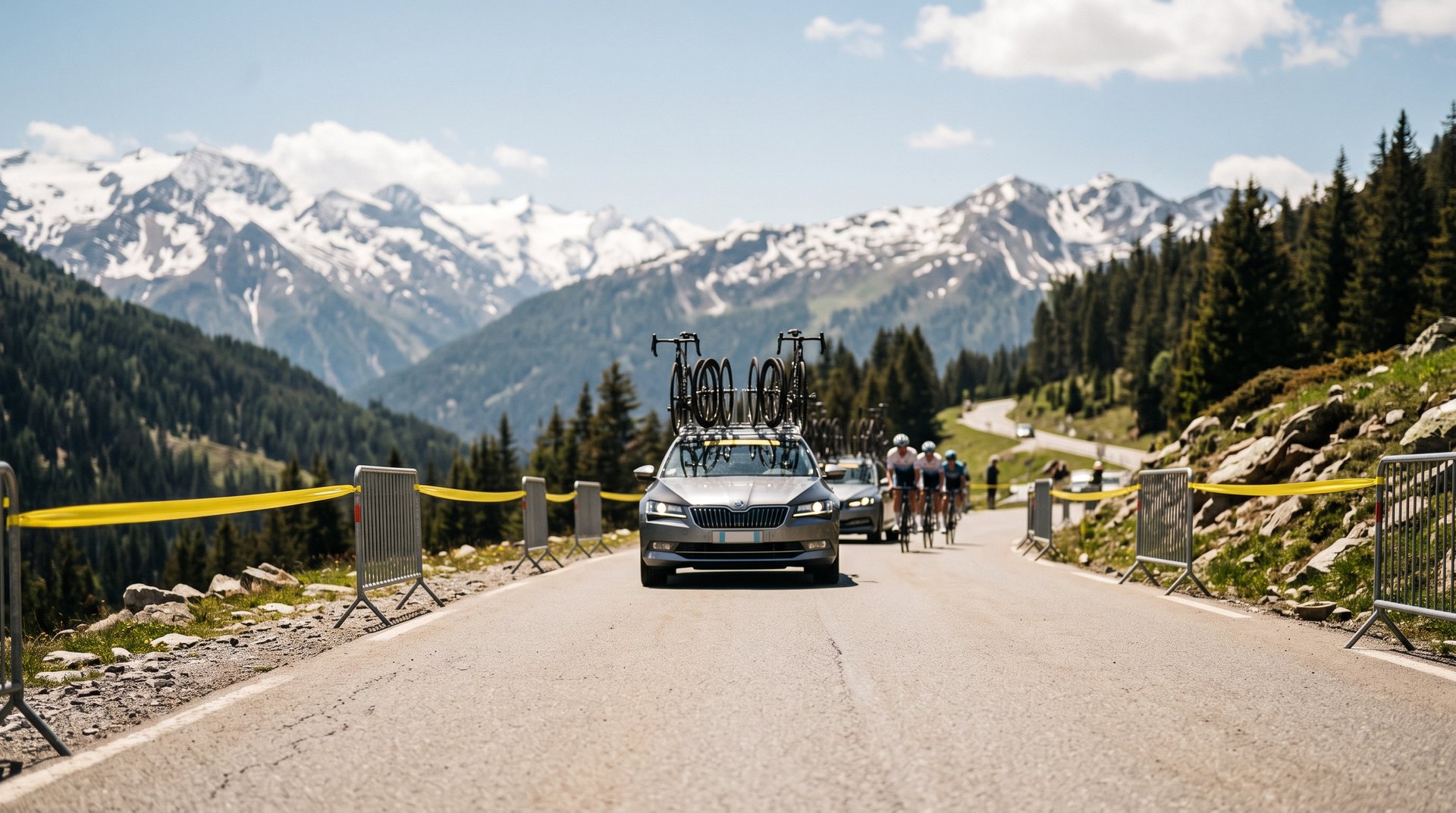
The Tour de France is one of the largest sporting events in the world, and for three weeks it behaves like a town that packs itself up every evening and rebuilds somewhere else the next morning. The riders are the visible part. Everything else is logistics.
The race: 3,383 km across 21 stages
The 108th edition covered 3,383 km in 21 stages over three weeks, with 184 riders on the start line — 23 teams of eight.
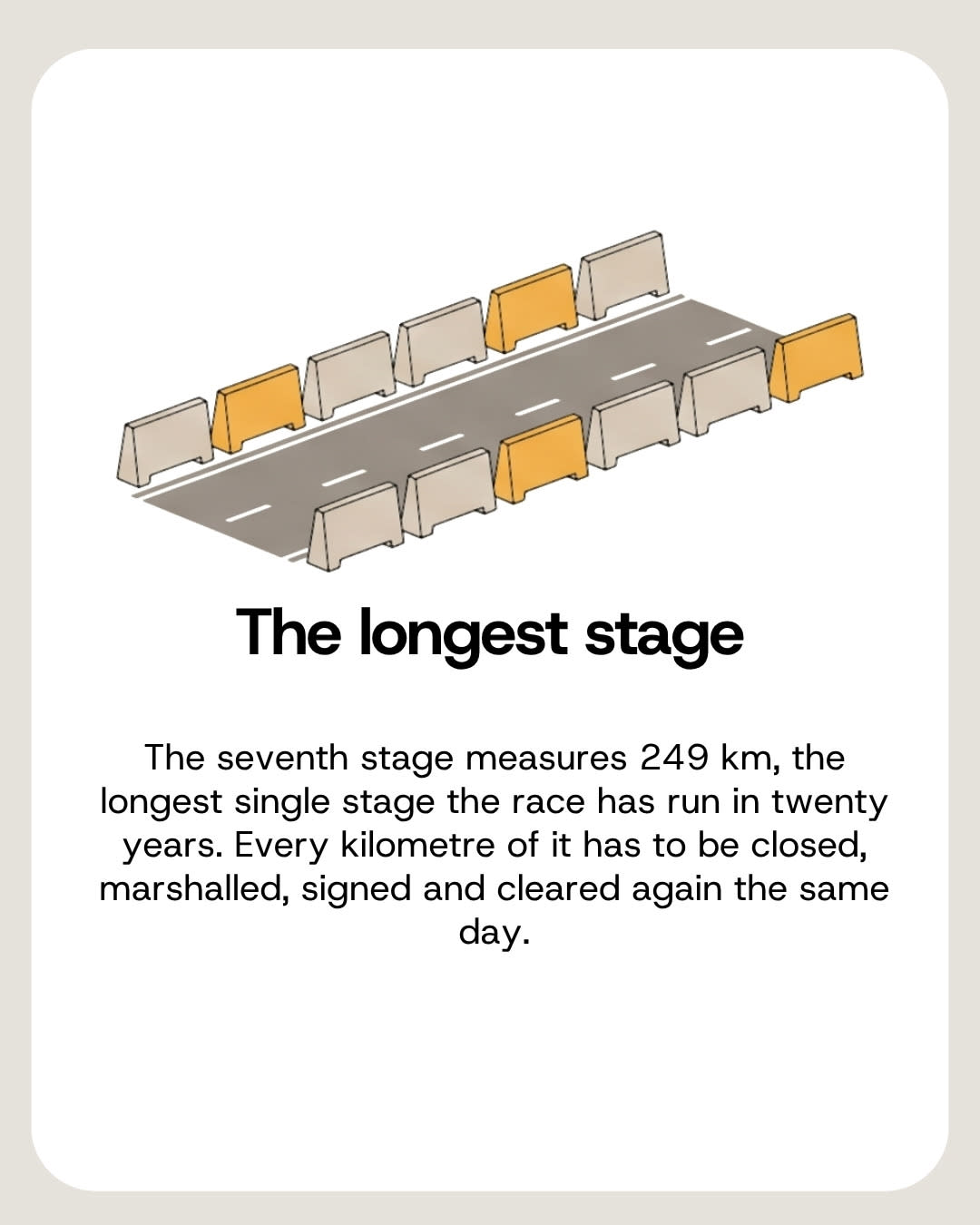
The seventh stage measured 249 km, the longest single stage the race had run in twenty years. Every kilometer of it has to be closed, marshalled, signed and cleared again the same day.
The people: 4,500 around the race
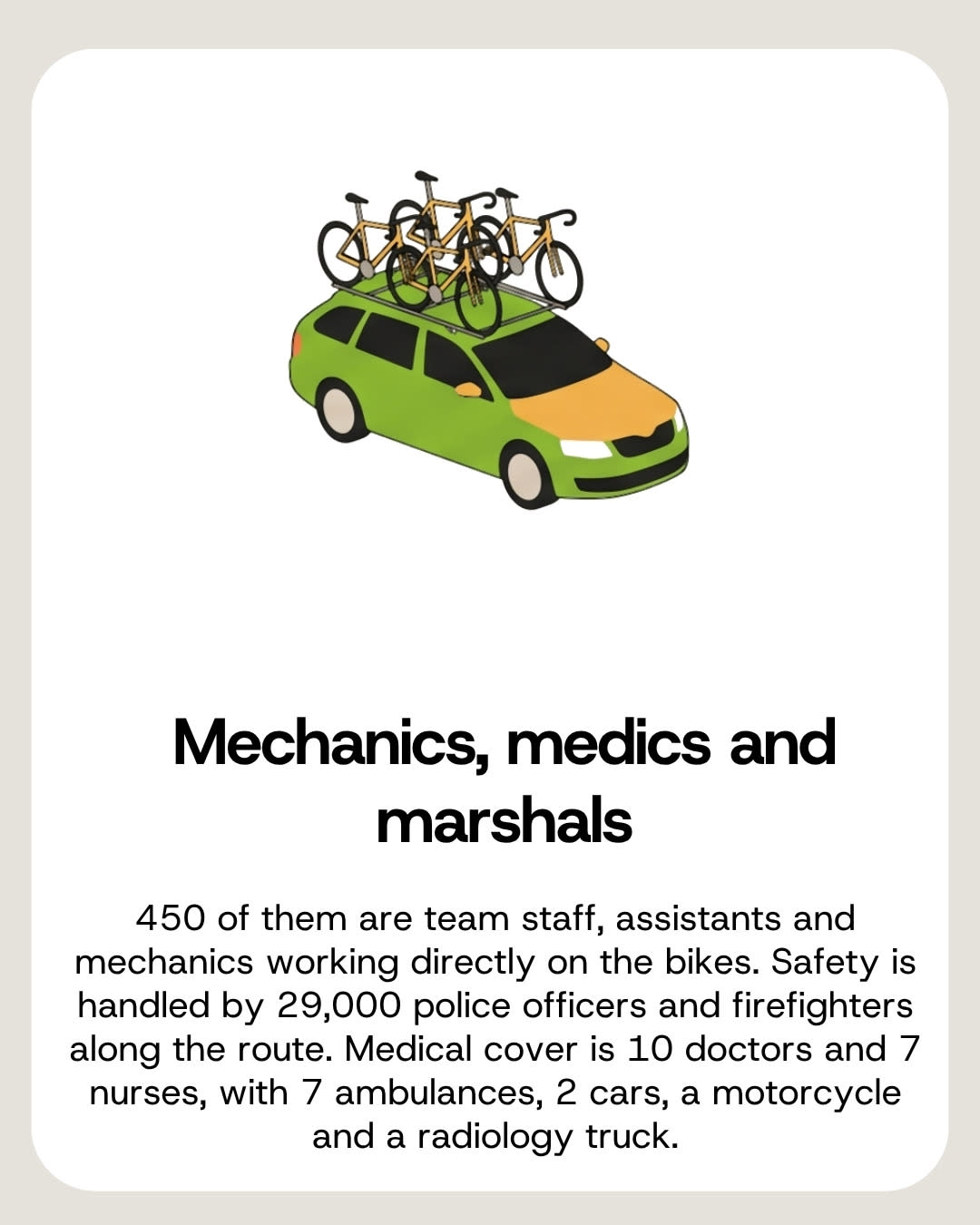
For every rider on the road there are roughly two dozen people making it possible. 4,500 people travel with the race: organizers, teams, media, partners, the advertising caravan and suppliers.
Of those, 450 are team staff, assistants and mechanics working directly on the bikes. Safety is handled by 29,000 police officers and firefighters along the route. Medical cover is 10 doctors and 7 nurses, with 7 ambulances, 2 cars, a motorcycle and a radiology truck.
The kit: rebuilt from scratch for every stage
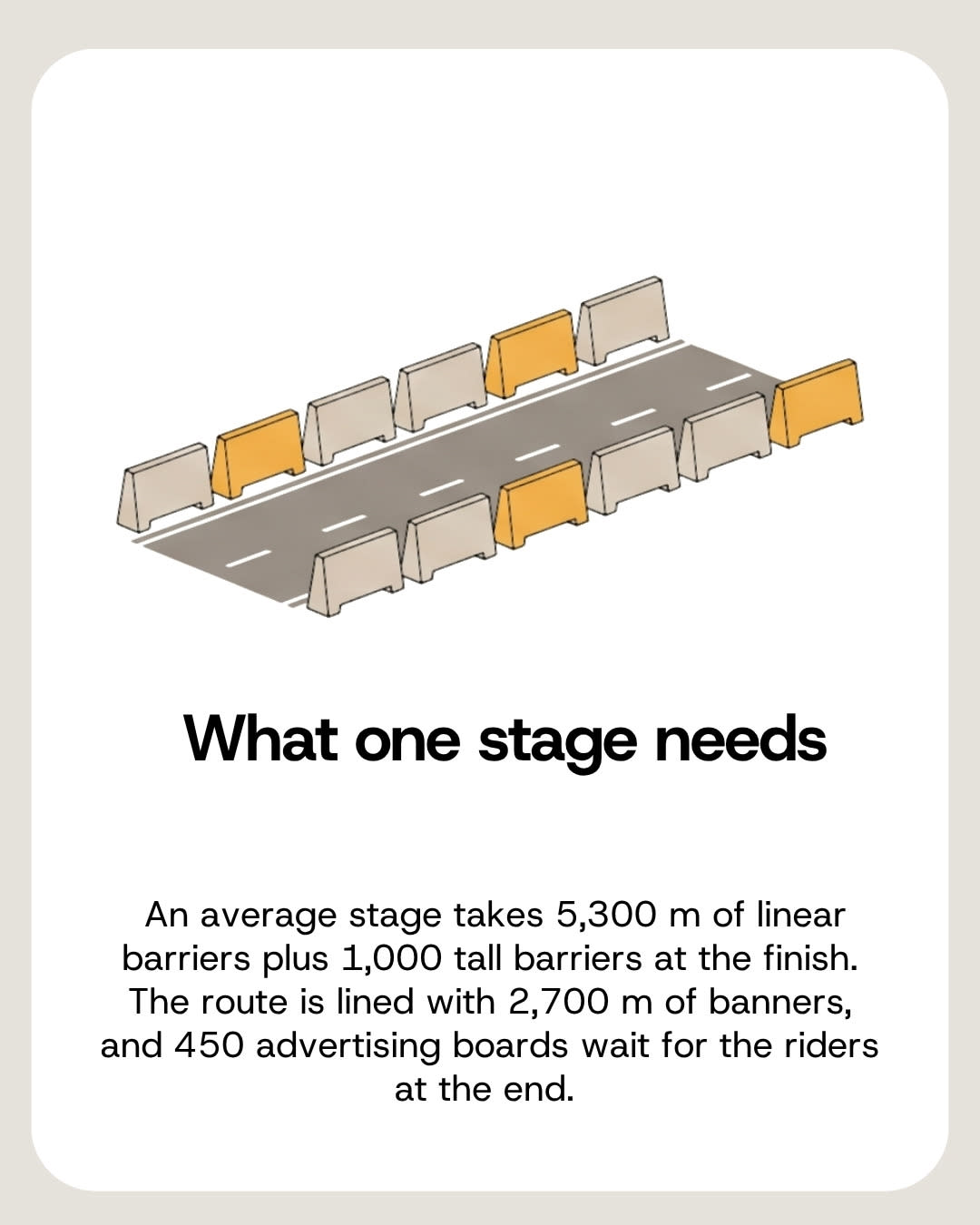
An average stage takes 5,300 m of linear barriers plus 1,000 tall barriers at the finish. The route is lined with 2,700 m of banners, and 450 advertising boards wait for the riders at the end.
None of it stays put. Everything that goes up in the morning comes down in the evening and goes up again somewhere else.
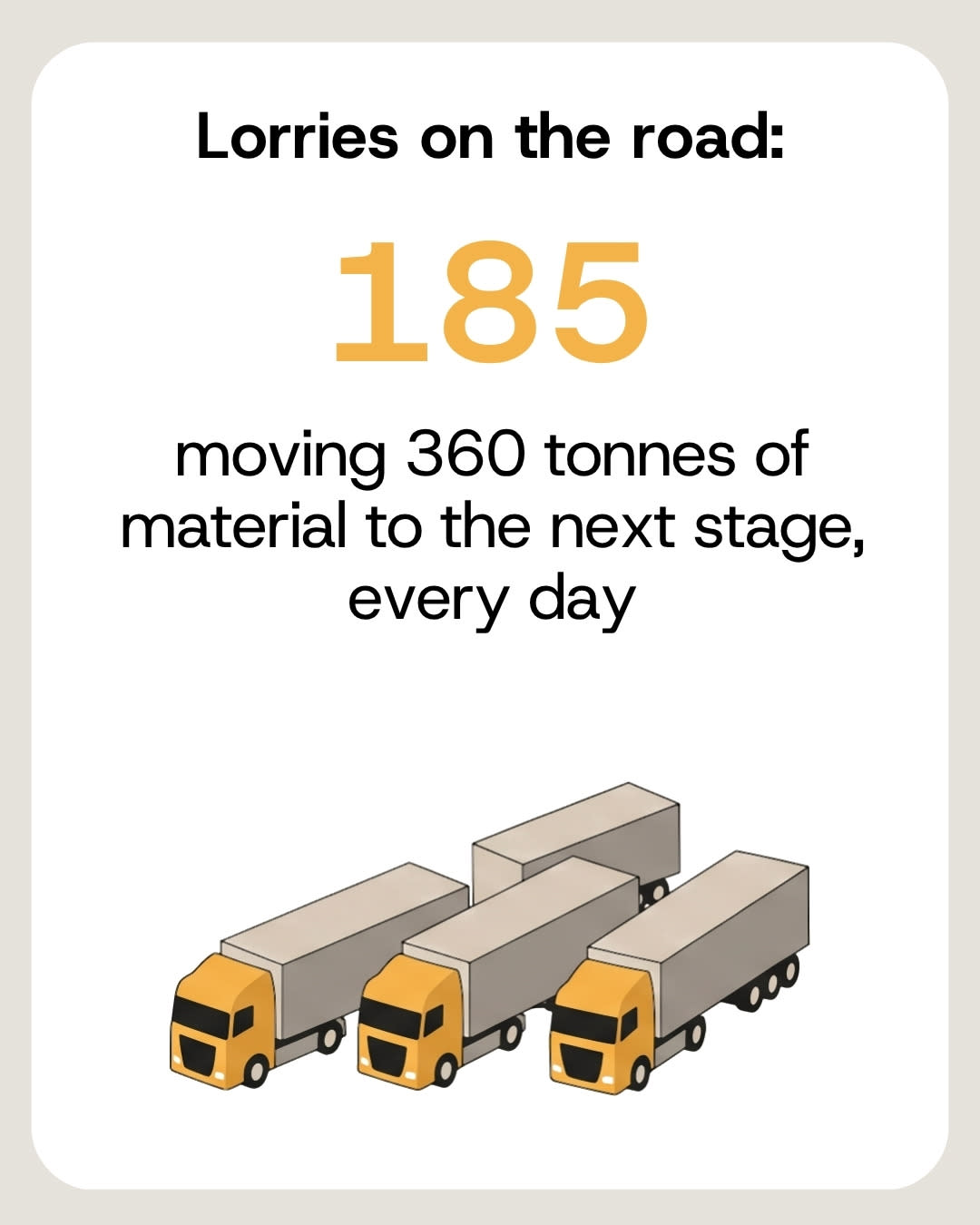
185 trucks, 360 tonnes, every day
185 trucks move 360 tonnes of material to the next town every day. There is no second attempt: the race arrives on schedule whether the barriers are up or not, so the whole convoy runs to a deadline that cannot move.
What to take from it
- 3,383 km across 21 stages, with a 249 km stage in the middle of it.
- 184 riders, 4,500 people and 29,000 police and firefighters.
- 5,300 m of barriers and 2,700 m of banners per stage.
- 185 trucks move 360 tonnes to the next town every day, with no second attempt.
When you look at an iceberg you only see part of it. The bigger piece is always below the waterline. An event like the Tour is the same — all we see is the riders. Behind every bread roll on a shop shelf there is complicated logistics and a tangled supply chain, and every piece has to arrive without trouble.
Jiří Dědeček, Consultant, Logio
Sources and dating
Figures describe the 108th edition of the Tour de France, run in 2021, and come from the organiser’s published race data.
Originally published as a Czech infographic in 2021. Redrawn and corrected in 2026 — the rider count in the original version was wrong.
Full infographic · PDF, 14 pages
The whole story in one file, with the figures and sources included.
Tour de France as a logistics project (EN)
PDF, 1.93 MB
More supply chain insights
Supply chain glossary
Category Management
What category management is, how category roles work, and why a category plan only takes effect once its role is translated into replenishment parameters.
14. october 2026
2 min
Supply chain glossary
Assortment Rationalization
What assortment rationalization is, what a delisting decision has to estimate, and why the phase‑out of remaining stock decides whether the savings appear.
13. october 2026
2 min
Supply chain glossary
Key Value Items (KVI)
What key value items are, how retailers identify them from basket data, and why a KVI price cut cannot be judged by the item's own sales.
11. october 2026
3 min