Infographics
Six days that stopped a trade route: the Suez Canal in numbers
More than a tenth of world seaborne trade goes through a canal that is single‑lane for half its length. When one ship wedged across it in March 2021, 369 ships queued for six days. What every alternative route costs in time.
13. september 2026
3 min
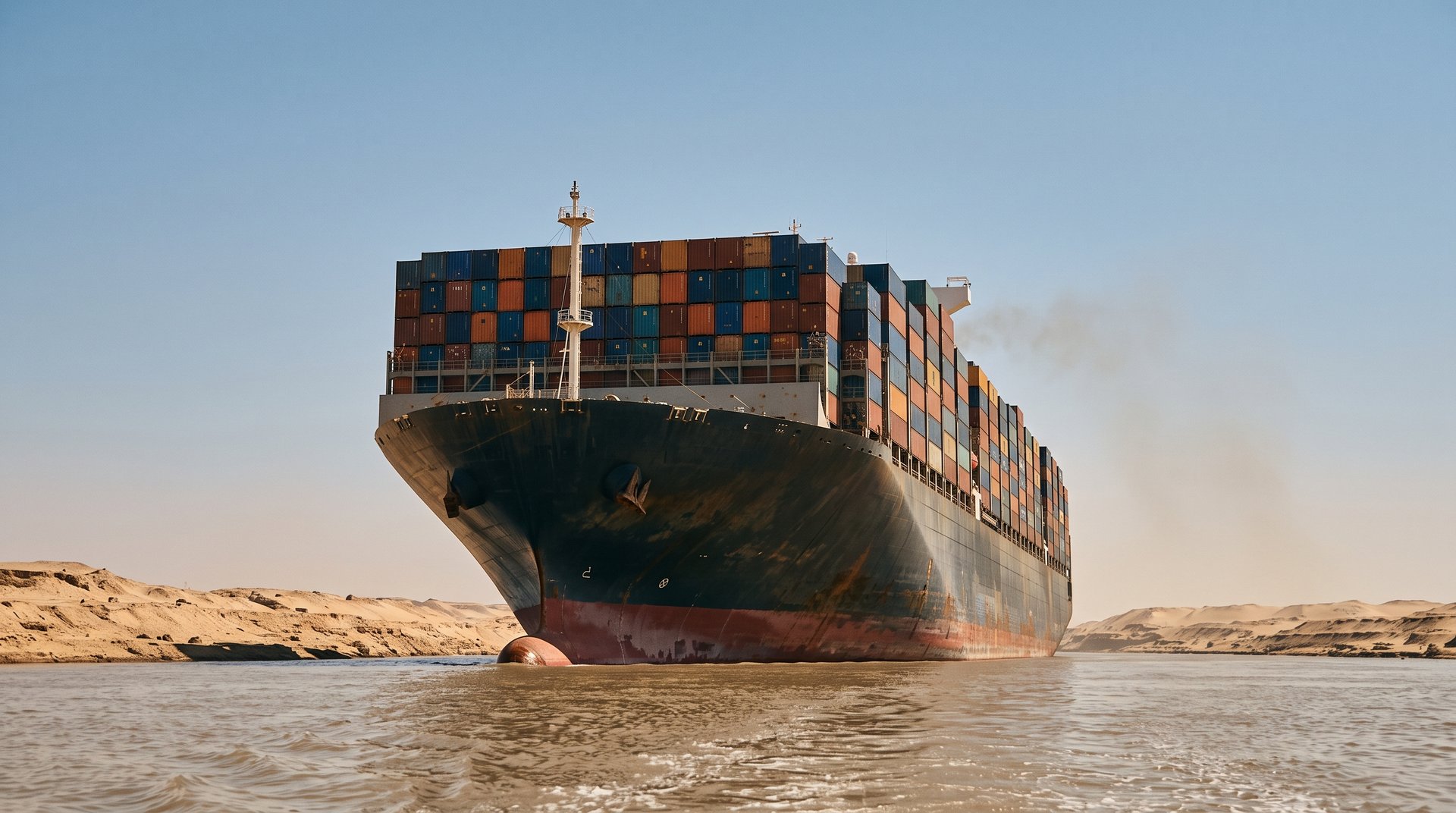
In March 2021 a single container ship turned sideways in the Suez Canal and closed it for six days. Behind her, 369 ships waited. This infographic follows what happened next: how much trade depends on that one waterway, what the detour around Africa adds, and which alternatives have since disappeared.
A canal that carries a tenth of world trade
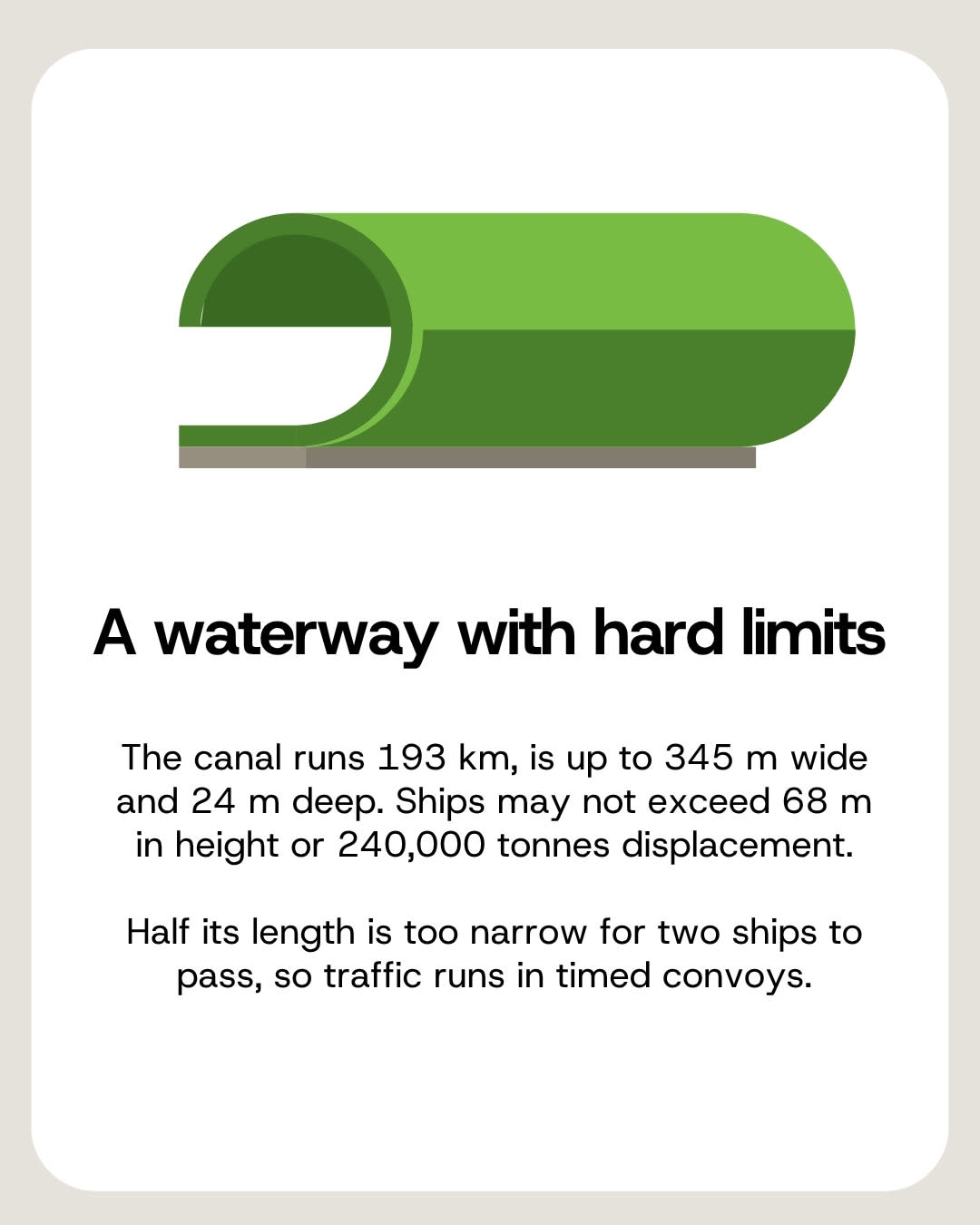
The Suez Canal has been open since 1869 and is still the shortest way between Europe and Asia. Around 12% of world seaborne traffic passes through it — roughly 19,000 ships and 983 million tonnes of cargo a year.
It runs 193 km, is up to 345 m wide and 24 m deep. Ships may not exceed 68 m in height or 240,000 tonnes displacement. Half its length is too narrow for two ships to pass, so traffic runs in timed convoys. That is why a single obstruction stops everything rather than slowing it down.
Six days in March 2021
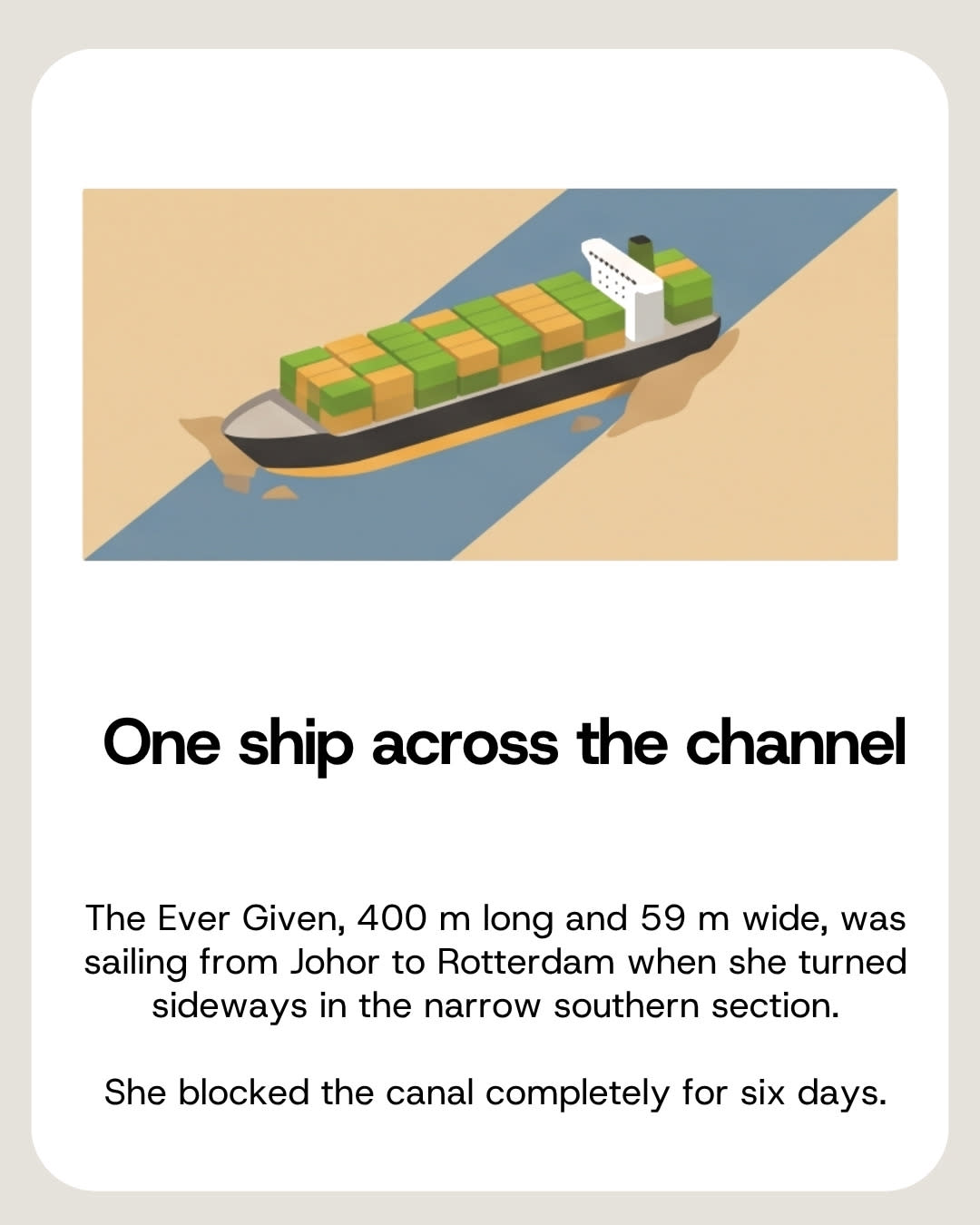
The Ever Given, 400 m long and 59 m wide, was sailing from Johor to Rotterdam when she turned sideways in the narrow southern section. She blocked the canal completely from 23 to 29 March 2021.
By the time it reopened, 369 ships were queued at both ends.
What the detour around Africa costs
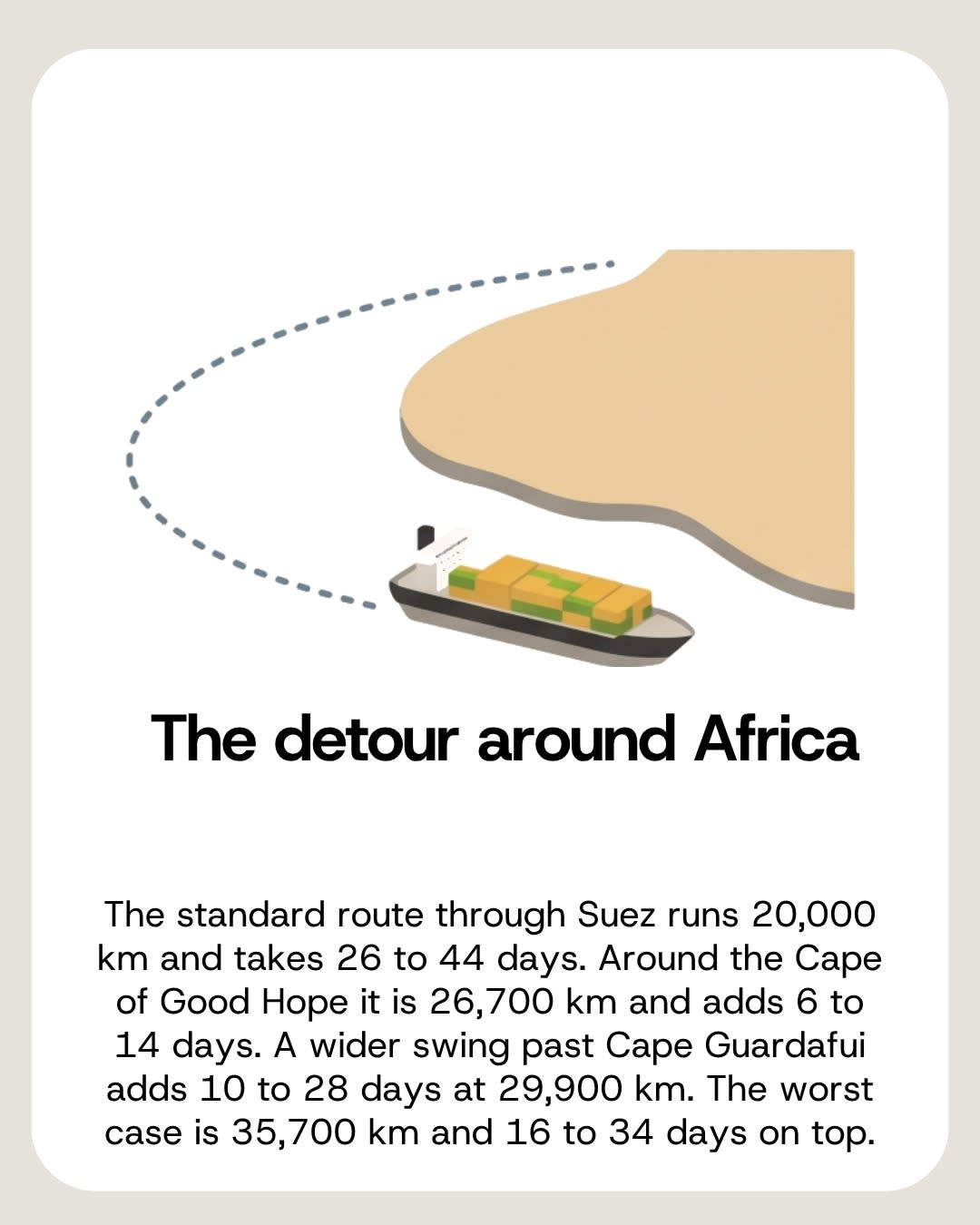
The standard route through Suez runs 20,000 km and takes 26 to 44 days. Around the Cape of Good Hope it is 26,700 km and adds 6 to 14 days. A wider swing past Cape Guardafui adds 10 to 28 days at 29,900 km. The worst case is 35,700 km and 16 to 34 days on top.
None of that is a decision made on the day. A ship already at sea has a limited set of options, and each one is measured in weeks.
Six ways to move cargo, and what each costs in days
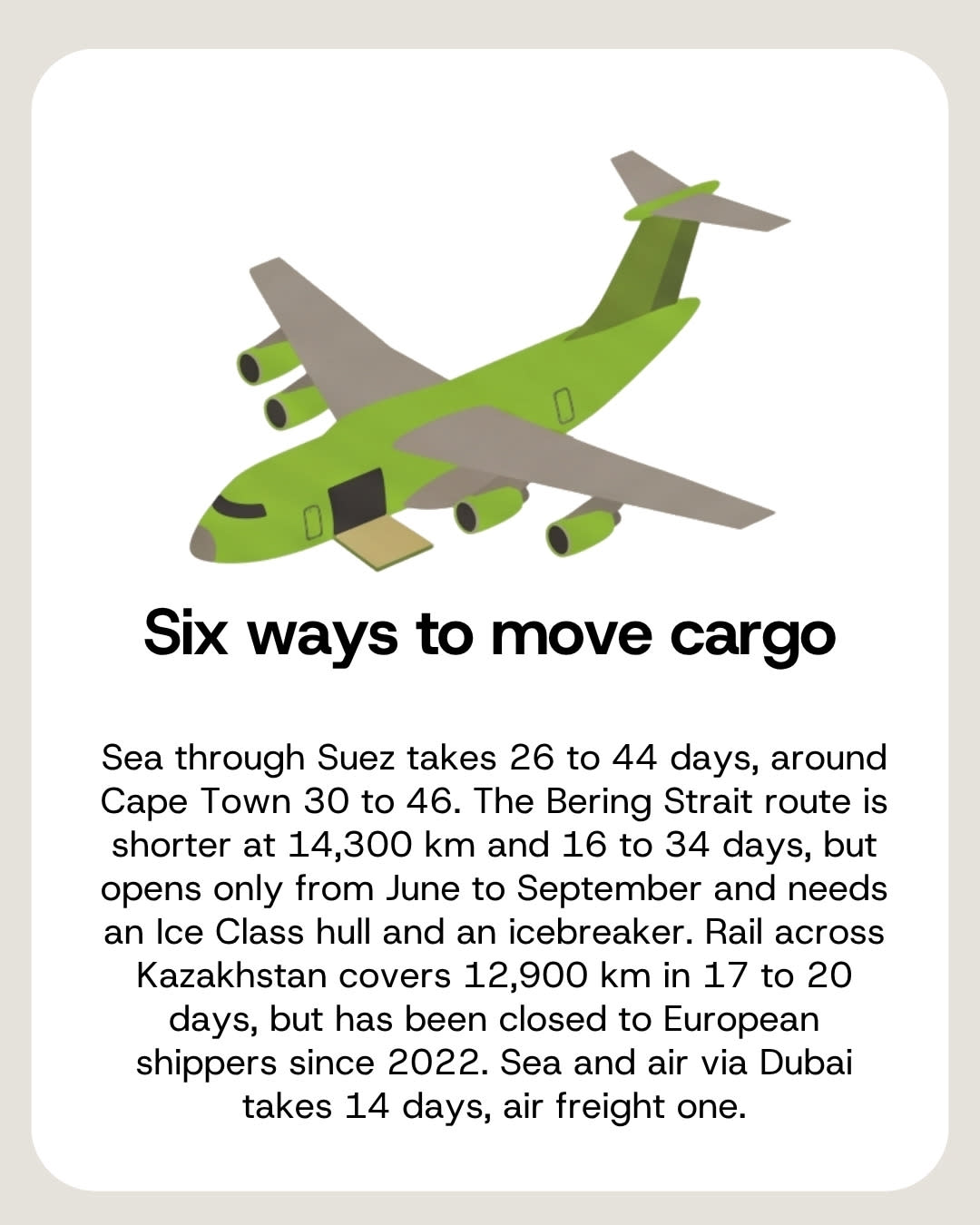
When nothing has sailed yet, the options widen — and so does the gap in transit time. Sea through Suez takes 26 to 44 days, around Cape Town 30 to 46. The Bering Strait route is shorter at 14,300 km and 16 to 34 days, but opens only from June to September and needs an Ice Class hull and an icebreaker. Rail across Kazakhstan covers 12,900 km in 17 to 20 days, but has been closed to European shippers since 2022. Sea and air via Dubai takes 14 days, air freight one.
What to take from it
- Over a tenth of world seaborne traffic goes through a canal that is single‑lane for half its length.
- Six days of closure put 369 ships in a queue.
- Going around Africa adds 6 to 34 days depending on the routing.
- Speed is buyable — air freight cuts weeks to a single day, at a cost no ordinary cargo justifies.
The point of a backup route is that you have worked it out before you need it. Once the canal is blocked, you are not choosing the best option — you are choosing what is still available.
Tomáš Formánek, Logio
Sources and dating
Suez Canal Authority, Freightos, SeaRates, WorldFreightRates. Distances and transit times describe the situation around the March 2021 closure.
Originally published as a Czech infographic in 2021. Redrawn and updated in 2026 — routes that have closed since are marked in the text.
Full infographic · PDF, 14 pages
The whole story in one file, with the figures and sources included.
Suez Canal: six days that stopped a trade route (EN)
PDF, 1.48 MB
More supply chain insights
Supply chain glossary
Product Portfolio Optimization
What product portfolio optimization is, how it differs from store assortment, and why each extra variant raises inventory even when sales stay flat.
19. october 2026
3 min
Supply chain glossary
Planogram
What a planogram is, what it specifies, and why its shelf capacity has to fit the delivery cycle and the case pack.
19. october 2026
3 min
Supply chain glossary
Long Tail
What the long tail of an assortment is, why it should be ranked per store cluster, and how pack sizes decide tail inventory.
18. october 2026
3 min